The Path to Better Accessibility and Liquidity for Zano

Zano has built a state-of-the-art ecosystem with privacy at its core.
Ring signatures hide the sender. Stealth addresses hide the receiver. Asset types are blinded. Pedersen commitments hide the amounts. Zarcanum made staking possible without revealing anything: the first private Proof of Stake in crypto. Confidential Assets let anyone issue a token that inherits all those guarantees.
That work is done, and it works exactly as intended. But that privacy is also what keeps Zano at arm's length from the rest of crypto. How does someone actually buy $ZANO? And once they hold it, is there anywhere for liquidity to gather?
Here's what those problems look like up close, and what we're doing about them.
The Ceiling Above: Why Tier-1 Exchanges Keep Saying No
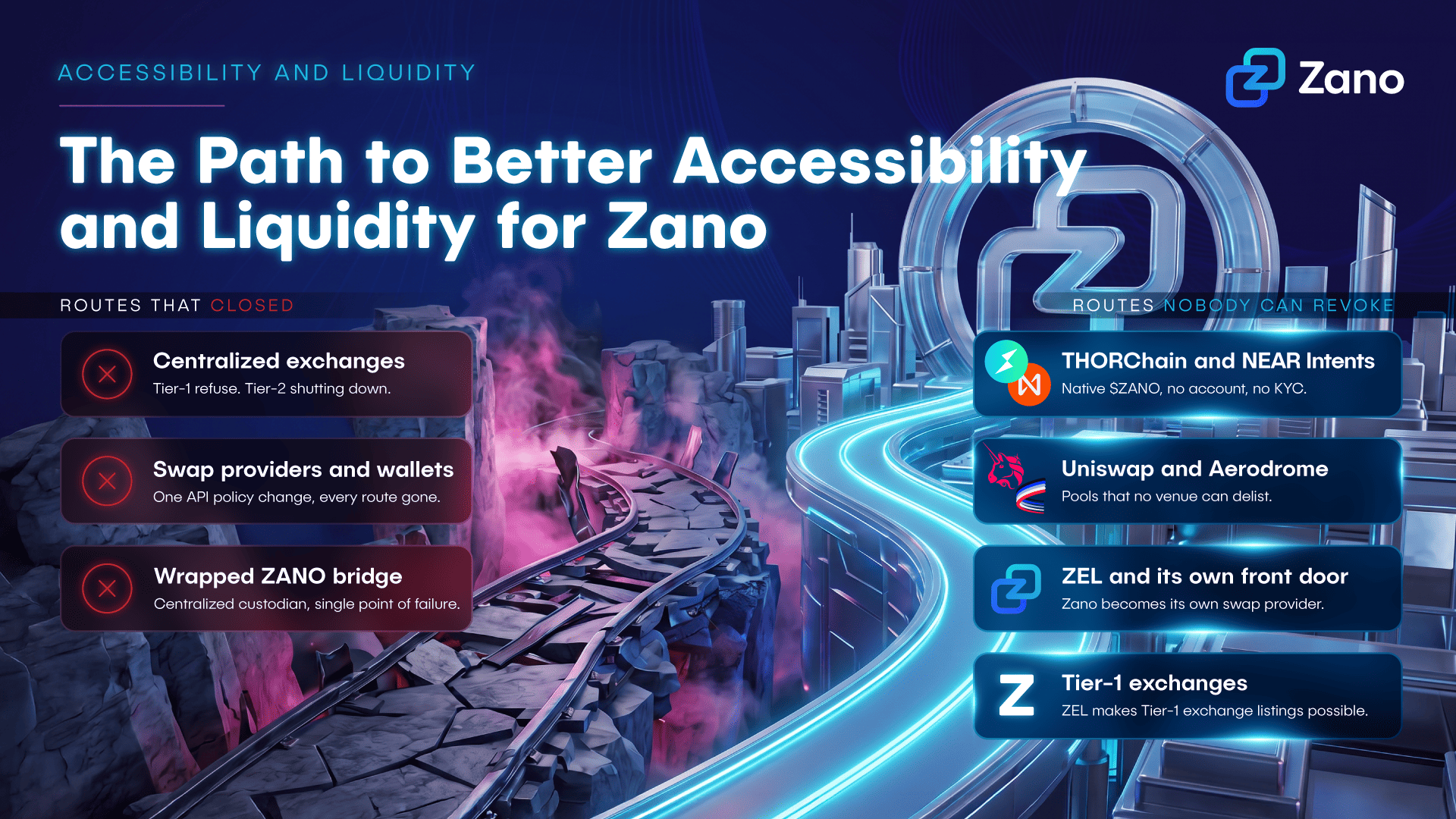
Native $ZANO has run into hard resistance from tier-1 exchanges. The features that make it technically superior, privacy enforced at the protocol level instead of offered as an option, are precisely the features that get it rejected. Compliance departments at the biggest venues won't touch a coin with default transaction privacy, and no amount of engineering quality moves them.
That's a ceiling, and it isn't one we can engineer our way through directly. It pushed $ZANO's listing footprint down to mid-tier centralized exchanges and swap services. Functional, but not where most people already have an account, and nowhere near where a newcomer with a bank card would ever start.
And that mid-tier is now disappearing. AscendEX ceased operations on 1 July 2026, citing its failure to secure authorization under the EU's MiCA regime alongside financial difficulties. BitMart announced its wind-down three weeks later and ended trading on 26 August. CoinEx, nine years old, announced this month that it'll stop trading on 22 December, pointing to falling volumes, thinning liquidity and the rising cost of staying compliant. $ZANO was listed on all three. None of it had anything to do with Zano. These exchanges didn't drop the asset; they stopped existing.
Read those three reasons together, and the trap comes into focus. The same compliance environment that keeps privacy coins out of tier-one venues is making tier-two venues unviable. We got pushed down into a category of exchange that's being squeezed out of existence, and the squeeze comes from the same direction as the ceiling. It's a space closing from both sides at once.
When the One Open Door Closed
MEXC became our primary exchange. For a long time that worked, mainly because MEXC didn't enforce KYC, which suited a privacy-focused user base.
In early 2026, MEXC started enforcing it. Predictably, a big share of $ZANO buying and selling moved off the exchange and onto swap platforms like Exolix, StealthEX and LetsExchange, where you can trade without an account or identity verification.
A great temporary solution, right up until it wasn't.
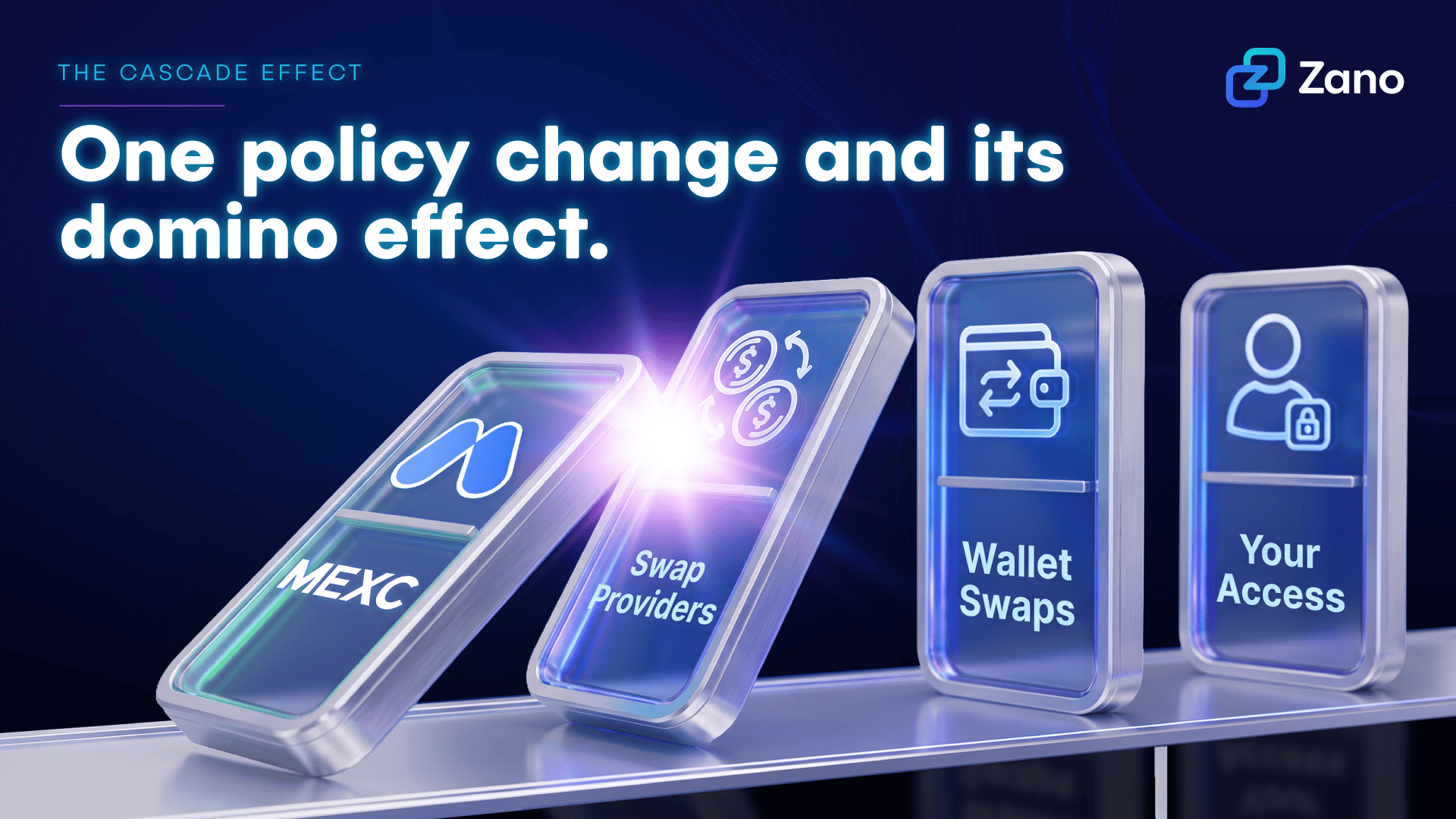
Those swap platforms aren't order books. They're routing layers, and they source their liquidity from centralized exchanges through API access. Think of them as a storefront with no warehouse behind it. For $ZANO, they were largely routing to MEXC, which meant they were a way to reach MEXC's liquidity without MEXC's KYC. The traffic had moved. The dependency hadn't.
Around June 2026, MEXC adjusted its API policy in a way that made it unworkable for swap providers to keep using it. With their liquidity source gone, those providers delisted $ZANO one after another.
The damage didn't stop there. We'd spent years getting integrated into self-custody wallets: Cake Wallet, Edge, Bitcoin.com, Unstoppable. Those wallets don't run their own exchanges. Their in-app swap features are powered by the very swap platforms that had just dropped $ZANO. So when the providers delisted it, the swap function went dark inside every one of those apps too.
That's the part that hurt. The integrations still exist. You can still hold, send, and receive $ZANO in those wallets. But being able to acquire it or exit it without ever leaving self-custody simply stopped working, because of a decision made somewhere else entirely.
Nothing about our technology caused this. No bug, no exploit, no protocol failure. A third party changed a business policy, and our accessibility collapsed because too much of it rested on one venue.
Why the Decentralized Escape Hatch Was Closed Too
The obvious answer to a centralized exchange revoking access is to stop depending on centralized exchanges. Cross-chain DEXes like Thorchain, Maya Protocol, and Near Intents route serious volume with no accounts, no KYC, and no single company able to switch a market off.
We couldn't get on them. And the reason is more specific than "integration is hard."
Thorchain and Maya don't wrap or peg anything. They hold native assets directly in threshold-signature vaults controlled jointly by their validator sets. That design carries a hard requirement: the network has to be able to verify, continuously and from the outside, that a vault actually holds what the protocol believes it holds.
Thorchain enforces this with an automatic solvency checker. On every connected chain, each node independently compares the balance the protocol has recorded for a vault against the balance actually sitting in the corresponding on-chain wallet. If the recorded value exceeds the real one by more than 1%, that node reports an insolvency, and if more than 66% of nodes agree, trading on that chain halts automatically. Maya, a friendly fork of Thorchain, inherits the same machinery.
It's the crypto equivalent of an auditor walking into the warehouse to count the pallets. Both checks depend on reading an external chain's balance, and on Zano, that balance was hidden. Not restricted, not permissioned, but cryptographically invisible, which is the entire point of the chain. A Thorchain node had no way to look at a Zano vault and confirm anything at all. Without that, the protocol's core safety mechanism can't run, and no serious network lists an asset it can't verify it holds. Near Intents gets there by a different route, since its solvers have to price and verify inventory on every chain they quote, but it ends at the same wall.
On top of that sat the general integration cost. Our UTXO model is core to how we deliver untraceability and hidden amounts, so it isn't going anywhere, but it makes life hard for any service moving funds at scale. Checking a balance means reconstructing it from scattered outputs. Standard custody tooling, MPC frameworks included, was never built for UTXO privacy chains. Coming back from downtime means a full resync, which for an exchange or a bridge costs money and burns trust.
So integrating Zano meant solving problems that don't exist on Bitcoin or Ethereum, and that pushed us down every integration priority list. A project that can't be integrated cheaply can't diversify its access points, and that's how a single exchange ends up carrying an entire on-ramp.
Let's be precise about what this isn't, though, because it gets misread. It isn't "privacy chains can't be integrated." Maya's validators already custody Zcash and Dash alongside Bitcoin and Ethereum. Zcash works there because it offers transparent addresses next to its shielded ones, so a vault can be publicly verified even on a chain where user privacy is available. The problem was never that Zano is private. It's that Zano offered no transparent option at all for the services that need one.
And Nowhere in Between for Liquidity to Sit
Thin liquidity usually gets treated as a marketing problem. For us it was an architectural one.
Zano has no smart contracts on its base layer. That's a deliberate choice, and the right one: the same decisions that make the privacy guarantees strong are what keep the protocol focused and free of a programmable attack surface. But it also means native DeFi can't exist here. No liquidity pools, no lending markets, no yield strategies. Nowhere for capital to sit and do work.
The workaround was $wZANO, an ERC-20 on Ethereum. It served its purpose, but it was always a compromise. The bridge ran on centralized server infrastructure operated by the core team, which meant periodic downtime and a single point of failure. More fundamentally, it meant a centralized custodian holding the native $ZANO on the other side. For a project whose entire value proposition is trustless, protocol-enforced privacy, that was an uncomfortable place to be, and it capped how much serious capital would ever route through it.
So: a compliance ceiling above, a fragile on-ramp below, the decentralized alternative structurally out of reach, and no venue in between where liquidity could gather. That's the full picture, and it's worth stating plainly before we talk about solutions.
Gateway Addresses Open Zano Up to the DEXes
Hard Fork 6 activated on mainnet at block 3,833,000 in late August 2026, after more than a year of work. The feature doing the heavy lifting is Gateway Addresses.
A Gateway Address is a new address class that works like an account instead of a UTXO wallet. Instead of scattering funds across spendable outputs that must be scanned and reassembled, it keeps a single, directly tracked on-chain balance. For an operator, the experience shifts from "scan the chain and rebuild the state" to "here's your balance."
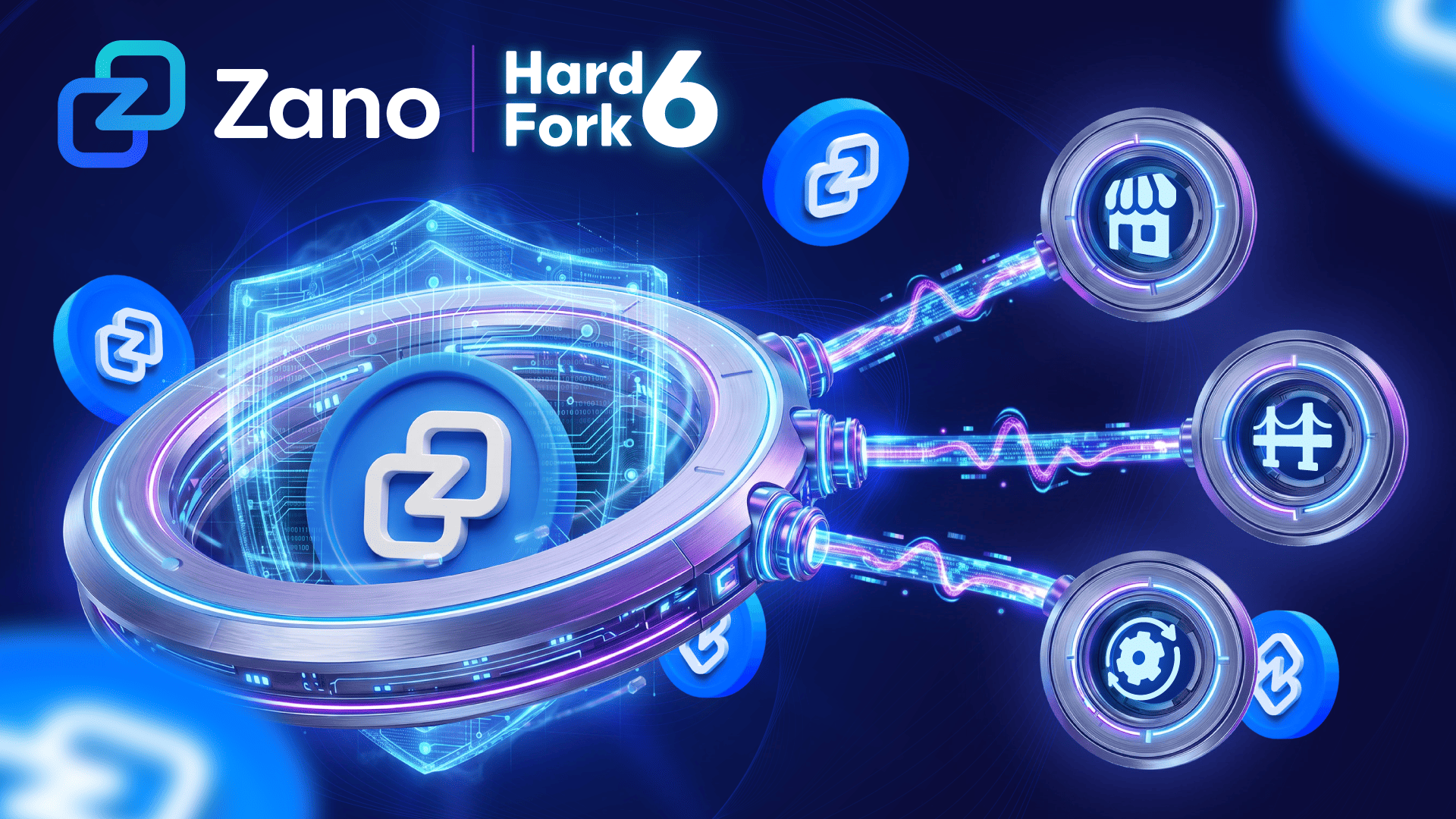
That unlocks three things:
An open, verifiable balance. The balance is readable straight from a node. This is the piece that was missing, and it's exactly what a Thorchain node needs in order to compare what the protocol believes a vault holds against what it actually holds. The solvency check that could never run on Zano can now run.
Instant sync. No scanning, no reconstruction, no waiting. A service can go offline and come back at full operational speed, so downtime stops being an integration risk.
Familiar tooling. The account model exposes a simple API much closer to what services already build against on Bitcoin and Ethereum, so established custody frameworks including MPC work as intended. UTXO fragmentation stops being a problem to solve.
Registration is permissionless, gated by a 100 ZANO fee that gets burned. That keeps it in the hands of serious service operators rather than casual users, and every registration adds to the deflationary side of $ZANO's supply.
Crucially, none of this touches the privacy layer. Standard Zano addresses work exactly as they always have. Gateway Addresses are an additional class built alongside the existing architecture, not a replacement for any part of it. Even when funds move into one, your identity as sender stays protected: a Zano transaction carries no sender field, only references to one-time output keys that can't be tied back to your public address, and ring signatures stop an observer from working out which of those outputs was actually spent. What becomes visible is the Gateway balance and the amounts arriving there, which is precisely the transparency a service needs to function. The team is researching whether future versions can support hidden amounts as well.
This isn't theoretical anymore. Thorchain is integrating the Zano blockchain now, we're working on the Near Intents integration ourselves, and Maya Protocol is on our radar.
It's worth being clear about what that produces, because it's a different category of win than a listing. Thorchain doesn't wrap or peg assets, so this means native $ZANO in native vaults, swappable against Bitcoin, Ethereum, and everything else on the network. It applies to Confidential Assets too. No account, no identity verification, no company in a position to revoke access. And because Thorchain liquidity is reachable through a wide range of wallets, aggregators and front ends rather than one website, a single protocol-level integration multiplies into many points of access.
Which points straight back at the wallets. Cake Wallet, Unstoppable and Edge already route their in-app swaps through Thorchain. When native $ZANO is live there, the swap function that went dark in those apps can come back on, powered this time by a permissionless protocol instead of an API key somebody else controls. Same experience for you, completely different foundation underneath it.
ZEL and the Transparent Side of Zano
Permissionless DEX access solves one vertical. It doesn't solve the compliance ceiling, and it doesn't by itself create a place for deep liquidity to gather. That's what the Zano Execution Layer is for.
ZEL is a separate EVM chain with its own Proof of Stake consensus and its own finality, connected to Zano through a threshold-signature bridge. Native $ZANO locks in a visible Gateway Address on Zano and is represented one-to-one as the native coin on ZEL, so gas is paid in $ZANO rather than in some new inflationary token. It replaces the old centralized wrapped-ZANO bridge outright.
The architecture, the security model, and the rollout get an article of their own. What matters here is what it opens up.
From ZEL, $ZANO becomes bridgeable to transparent chains. Three destinations matter, for three different reasons.
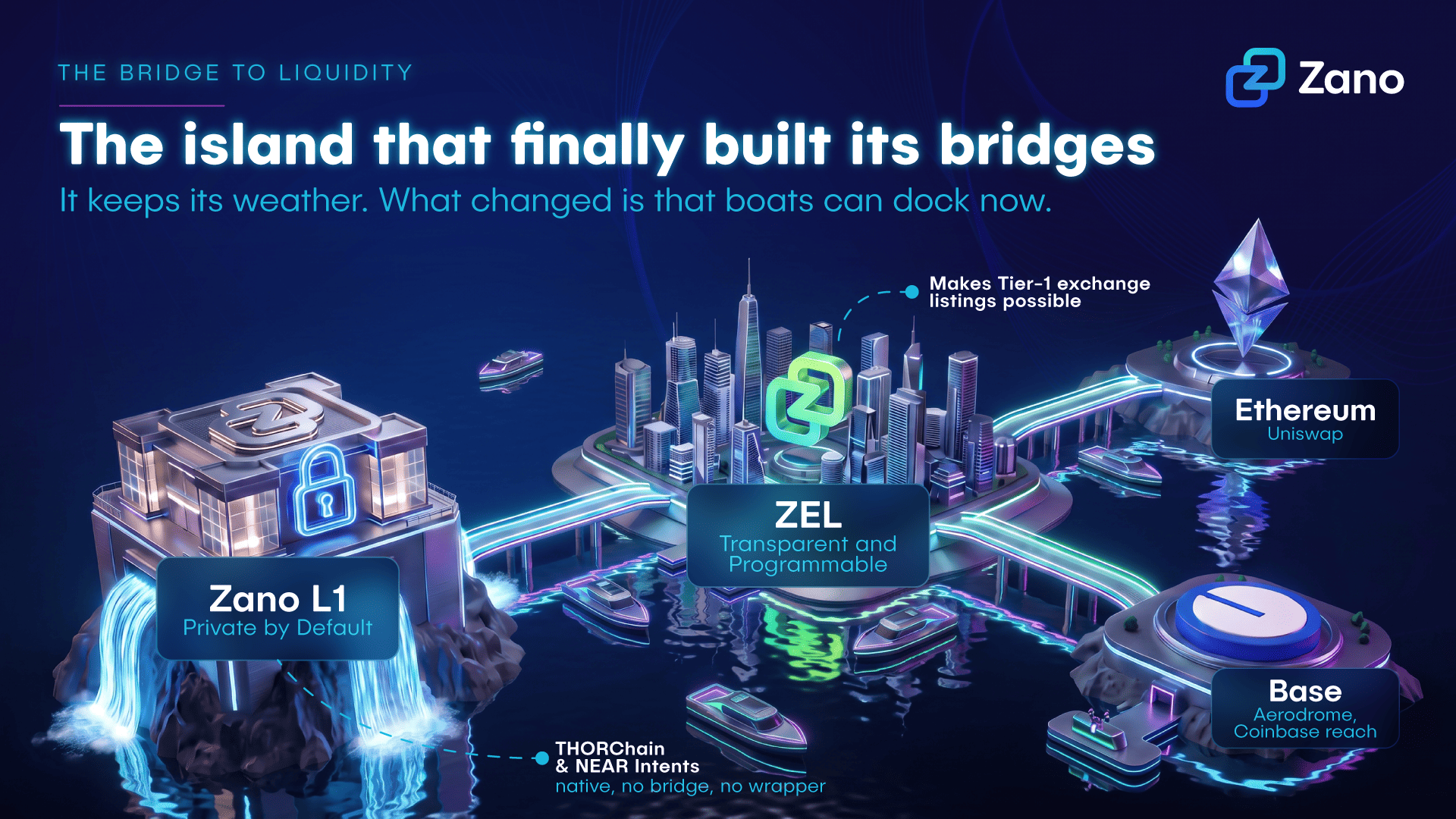
Ethereum. $ZANO on Ethereum means a Uniswap pool, and a Uniswap pool can be incentivized to attract liquidity providers. Deep, permissionless, on-chain liquidity that no venue can delist.
Base. This is the one to pay attention to. $ZANO on Base means an Aerodrome pool, and Aerodrome is one of the pools Coinbase's in-app DEX aggregators already scan. Coinbase doesn't "list" assets in the traditional sense on that surface. A token that exists on Base becomes discoverable and tradable inside the Coinbase app within hours of being indexed, with no listing process and no approval required. We wouldn't be asking a listings committee for permission. We'd be reaching Coinbase's retail distribution through the side door. Trades settle through an integrated self-custody wallet, so users end up holding their own keys by default, one step away from bridging home.
ZEL itself. ZEL is transparent and programmable, and EVM chain exchanges can integrate with tooling they already have. That's the retail door: a centralized exchange that won't touch a privacy L1 has no equivalent objection to a standard asset on a standard EVM network. ZEL is also the programmable venue we deliberately won't build on the base layer, with AMM pools, a swap router, pooled lending markets, and a core stablecoin. Somewhere for capital to sit and do work.
The pattern is the same across all three, and that's the point. An exchange that won't list a privacy coin has no compliance objection to $ZANO on Ethereum, Base, or ZEL, because all three are transparent by design. Services get to choose for themselves which chain they want to facilitate $ZANO trading on, instead of facing a single take-it-or-leave-it proposition their legal team was always going to decline.
This time, the front door is ours. Every previous version of this layer ran on infrastructure we didn't own. ZEL ships with its own interface: a web app where you bridge $ZANO and Confidential Assets between Zano mainnet, ZEL, Ethereum and Base, with further EVM and EVM-compatible networks to follow, and swap other assets into $ZANO directly, against deeper liquidity than the old routes ever had. Zano becomes its own swap provider.
That's the lesson of the last twelve months, applied. Every route to $ZANO used to be somebody else's product, which meant somebody else's decision could withdraw every route. A first-party interface exists whether or not any third party chooses to carry the asset.
Note what else that unlocks. Confidential Assets move across the bridge too, not just $ZANO. An asset issued on Zano is no longer confined to Zano.
The third-party routes get repaired as a side effect. The swap providers that delisted $ZANO did so because their liquidity source disappeared. Give them permissionless pools on Thorchain, Uniswap, and Aerodrome, plus ZEL's own venue, and they've got somewhere to route again that no exchange can revoke. The wallets sitting downstream of those providers get their swap function back along with them. The difference is that if any of them walks away a second time, it no longer takes our accessibility with it.
And the round trip stays clean. You buy $ZANO wherever is easiest, withdraw it over Ethereum, Base, or ZEL to your own self-custody wallet, and bridge it back to Zano's privacy L1. At that point, you hold native $ZANO with the full privacy stack intact: hidden amounts, hidden addresses, untraceable transactions. From a bank card to protocol-level financial privacy, with no custodian holding anything at the end of it.
Add it up, and the sentence that matters is this one: $ZANO stops depending on anyone's permission to be tradable.
Two things to be honest about, though. That's a narrower claim than "no gatekeepers," and deliberately so. Adding a new chain or asset to ZEL goes through validator governance, exactly as adding a chain to Thorchain does. What changes is who holds that decision, and whether any single company can reverse it on its own. And while your $ZANO is sitting on a transparent chain, it's transparent. Balances and history are publicly visible there like any other token, and the privacy only comes back when you bridge home.
The positioning hasn't shifted, and it's worth restating because it gets misread: Zano L1 stays private by default. Transparent smart contracts aren't coming to the privacy chain. They live on ZEL, where code, state, and execution are public and independently reviewable, which is where they belong.
This Is the Zcash Model, Upside Down
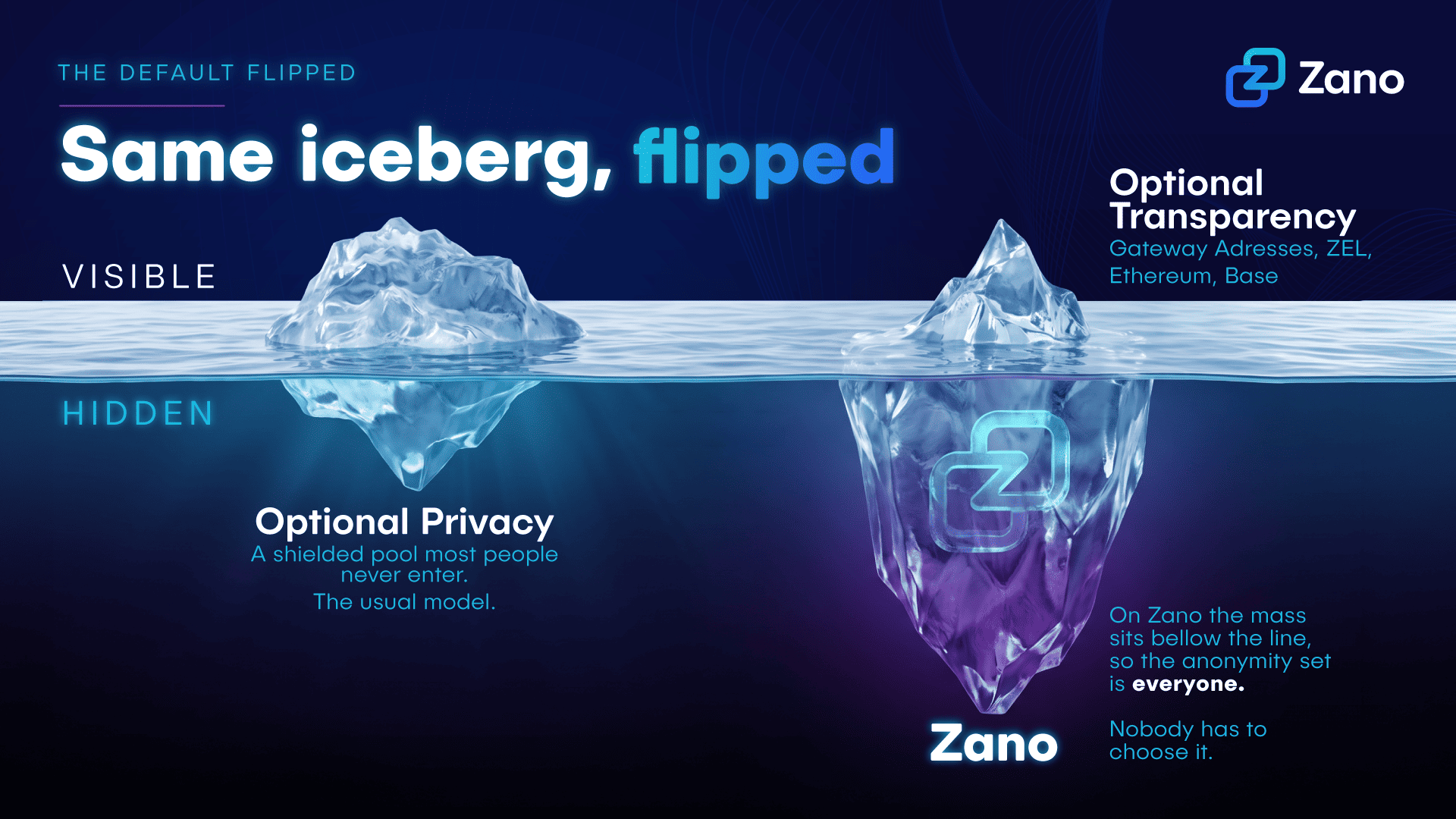
Remember the earlier point about Maya already custodying Zcash. Zcash works with these services because it offers transparent addresses alongside shielded ones. The base layer is transparent, and privacy is the thing you opt into.
Zano inverts that completely. The base layer is private, enforced at the protocol level for everyone, and transparency is the thing you opt into by moving to a Gateway Address or bridging to ZEL, Ethereum, or Base.
The difference isn't cosmetic, because defaults decide outcomes. On a transparent chain with optional privacy, the overwhelming majority of activity stays transparent, which is exactly what's happened with Zcash's shielded pool for most of its life. Privacy that requires a deliberate act is privacy most people never use, and a small shielded set is a weaker shielded set. On Zano, the anonymity set is everyone, because nobody has to choose it.
What HF6 and ZEL add is the exit ramp that was always missing. Not a compromise on the default, but an option next to it.
That's what makes this work across every vertical at once. Permissionless DEX trading of $ZANO and Confidential Assets, no KYC. Centralized exchange listings, through a transparent representation on whichever chain the exchange prefers. DeFi liquidity, on Uniswap and on ZEL. A fiat on-ramp, through Coinbase and Base. And underneath all of it, a private L1 that any of those users can bridge home to.
Where That Leaves Us
The last twelve months made the case better than any argument could. Our access to the market was never taken away by a technical failure. Other people's business decisions took it away, because we had no path that didn't run through them.
Hard Fork 6 removed the technical reason integrations were expensive, and the Thorchain and Near Intents integrations are underway. ZEL opens the transparent side: exchange listings that don't have to fight a compliance department, liquidity pools that can't be delisted, and a fiat route that ends in self-custody.
None of it is finished. More integrations still have to land, and ZEL's mainnet is still ahead of us. But the direction of travel is away from permissioned dependencies, and toward access nobody can revoke.
Privacy nobody can reach is a research project. Privacy the world can plug into is money. That's the one we're building, zAnons.