Zano Monthly Project Update #23 - August 2026

Welcome zAnons to the 23rd Zano Project Update!
August was the month the fork landed. Hard Fork 6 activated at block 3,833,000 on August 26, and everything it carries is now live on mainnet: gateway infrastructure, consensus-level limits on assets and gateway descriptors, the rebuilt decoy selection algorithm and months of hardening underneath. Away from consensus, the Zano Execution Layer stopped being a set of separate components and became one testnet configuration. Edge shipped Bridgeless into its wallet, putting private Bitcoin in front of an audience that never went looking for a privacy coin. Zano Quest, the campaign for creators and active community members, was built through the month and opens shortly. Let's dive in!
Table of contents
- Hard Fork 6 Is Live
- The Execution Layer Reaches Testnet Configuration
- Zano Quest
- Zano Spotlight: Edge
- Ecosystem Growth and Integrations
- Events
- Technical Upgrades
- Media Content & Coverage
- Zano Around the World
- Looking Ahead
Hard Fork 6 Is Live
Block 3,833,000 passed on August 26 and the network upgraded on schedule. Preparation was the main focus of core development all month, and the fork went through cleanly. Services that have not migrated should work through the HF6 migration guide and get onto the latest release. Everyone else needs a current wallet and a full resync, because an old client no longer follows the chain.
Gateway Addresses are the change that took a year to build. Integrating a UTXO privacy chain used to mean sync logic, coin selection, custom signing and a rescan after every period of downtime, which is the real reason so many exchanges quietly passed on listing $ZANO. A service now registers a Gateway Address and reads one account balance, and registration is permissionless and burns 100 $ZANO. The fork also brings stronger consensus and fork-choice rules, per-output payment IDs so a service can match a deposit to a customer without exposing the recipient, and wallet file encryption hardened with ChaCha20.
None of that changes how your wallet behaves. Everyday transactions are as private as they were on August 25. Gateway Addresses are opt-in infrastructure for services.
HF6 also opens movement in both directions. Native $ZANO is locked in a protocol-held Gateway Address and an equivalent amount of $wZANO minted on the destination chain; reversing it burns the $wZANO and unlocks the coins, backed 1:1 through threshold signatures rather than a custodian. Tier-1 exchanges have turned down native $ZANO on privacy grounds, while a transparent EVM asset lists easily: buy $wZANO with a card, withdraw to self-custody, bridge to native. Confidential Assets like $fUSD follow once the Execution Layer arrives.
Zano Fact: Did you know Gateway Addresses carry their own prefixes? Regular ones begin withgwZand integrated ones withgwiZ, so a service address is recognisable at a glance and can never be mistaken for a personal one.
The Execution Layer Reaches Testnet Configuration
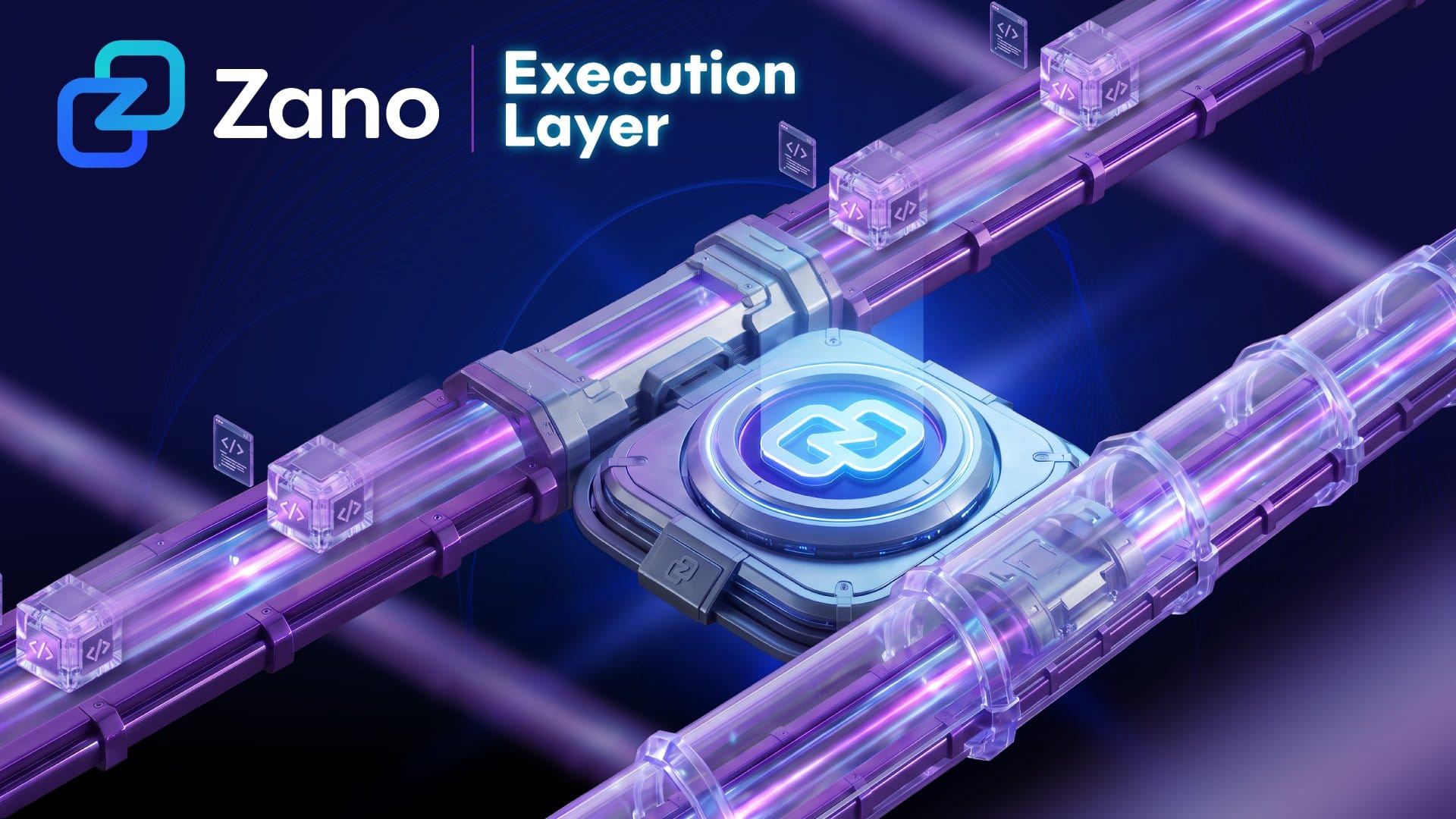
Smart contracts have never run on Zano L1, and that is deliberate: a public execution environment and a privacy chain want opposite things. The Zano Execution Layer is how both get to exist, a standard EVM alongside the privacy chain with bridged $ZANO as gas. Contracts stay public and verifiable, private assets stay private, and lending, borrowing, yield and liquidity provision with native $ZANO and Confidential Assets become possible.
Integration was the theme in August. Components built separately over previous months were brought onto a single testnet configuration. Bridge-in and bridge-out flows work end to end, with native and wrapped bridge addresses stored on-chain and an emergency stop mechanism for bridge transactions. Swap messages were implemented and integrated with the oracle service, and the oracle integration was reimplemented and merged into the core, refactored to run under the ZEL chain configuration (chain ID, address prefix, denoms) with its own CI pipeline.
Token info now carries metadata and decimals with a CLI for managing it, and Liquid joined the supported set. The ZEL block explorer moved to the testnet chain config and was prepared for publishing, while core CI/CD was overhauled with automated Docker image builds and hardened GitHub Actions.
By the end of the month, core, oracle and explorer were all running on the same testnet config, the last step before opening things up. Public testnet is still estimated for Q3 2026 and mainnet for Q4 2026, and the roadmap carries the current status.
Zano Quest
Most community campaigns reward whoever posts loudest for two weeks. Zano Quest is built to reward the people who stay. Developed through August and expected to launch soon, it pays XP plus physical and digital Zano rewards, with a leaderboard showing the top-performing profiles. Participation takes several forms:
- Content submissions. Rewards differ by content type, from memes at one end to high-effort ecosystem contributions at the other.
- Learn-to-Earn. Earn XP by learning how the Zano ecosystem works and passing the tests.
- On-chain tasks. Create an alias, interact with Zano Trade, join Zano Messenger.
- Referrals. XP for every user you bring into the campaign.
- Achievements. Badges that display on public profiles.
- Tiers. The more followers you have on X, the more XP your content earns.
XP is not only a scoreboard number. A store lets you spend it on physical and digital goods, or exchange it for $ZANO or $fUSD.
Zano Spotlight: Edge
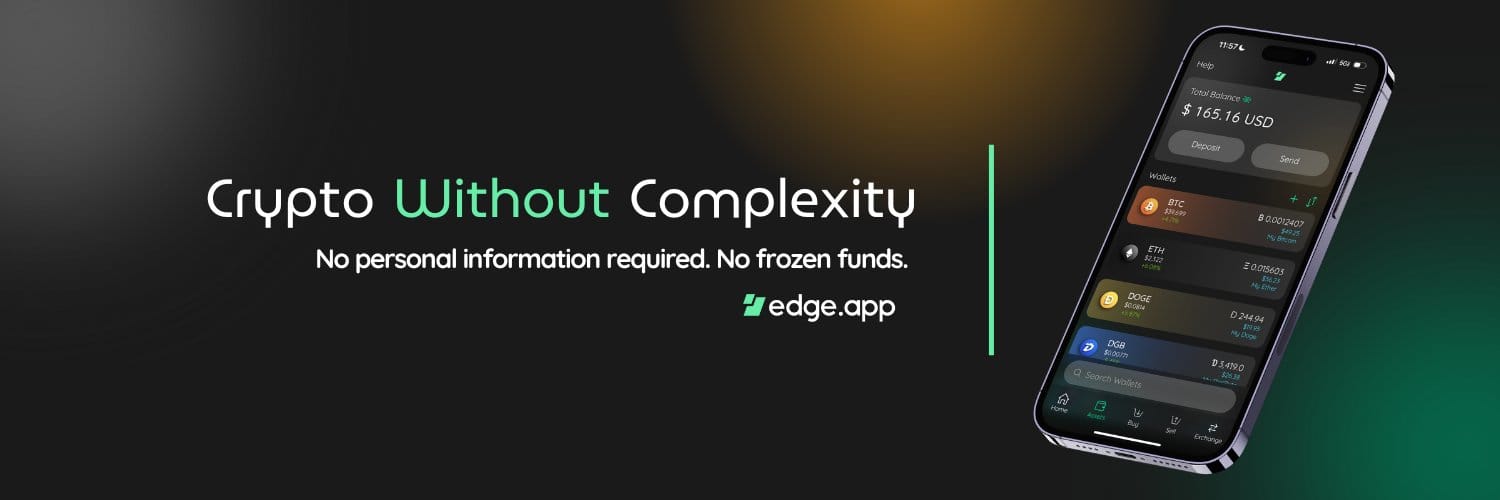
Edge is a non-custodial, mobile-first multi-asset wallet that has supported Zano for some time. Its latest release integrates Bridgeless and the Confidential Layer, so users can move assets from other blockchains onto Zano and hold them as Confidential Assets directly inside the app.
Privacy is not what most people get from the wallets they already use. Major cryptocurrencies are pseudonymous rather than private: every transaction sits permanently on a public ledger, and over time chain analysis links addresses and traces flows. Bridgeless brings assets from other chains onto Zano, where a corresponding token is minted. BTC becomes BTCx, ETH becomes ETHx, and so on. Those tokens live natively on Zano and inherit its privacy guarantees: amounts, senders and recipients stay confidential while remaining cryptographically verifiable. Supported confidential assets currently include BTCx, BCHx, ETHx, DAIx, BNBx, SOLx and TONx.
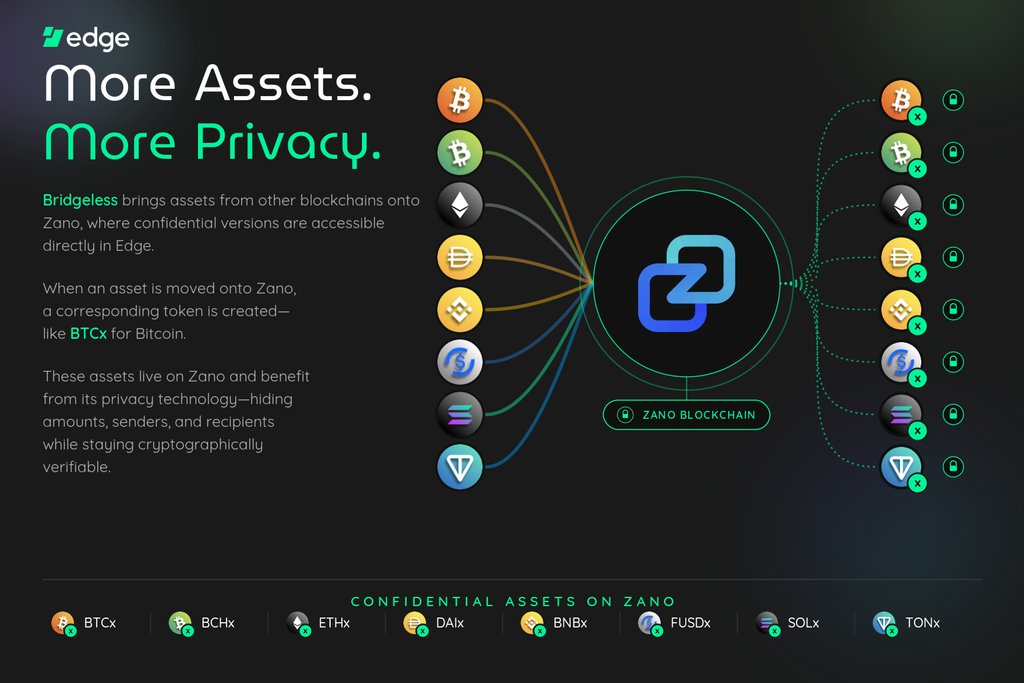
What makes it land is the user experience. Swapping into a confidential asset works like any other trade in Edge: open the Exchange scene, choose the asset to trade, select the confidential version you want to receive. No separate bridge interface, no address pasting, no registration, no approval step. Bridgeless handles the cross-chain mechanism in the background through its validator network and threshold signatures, and users keep their keys throughout.
For the ecosystem this is one of the more meaningful distribution wins so far. It puts private Bitcoin in front of a wallet audience that was not looking for a privacy coin, without asking anyone to learn new tooling. Edge's own position is that privacy should be a default rather than an advanced feature, and turning BTC into BTCx in three taps is close to that.
Try it at edge.app.
Zano Fact: Did you know the asset type is hidden on Zano, along with everything else? An observer cannot tell whether a transaction moved native $ZANO or a user-issued Confidential Asset, so every asset on the chain hides inside the anonymity set of every other one.
Ecosystem Growth and Integrations
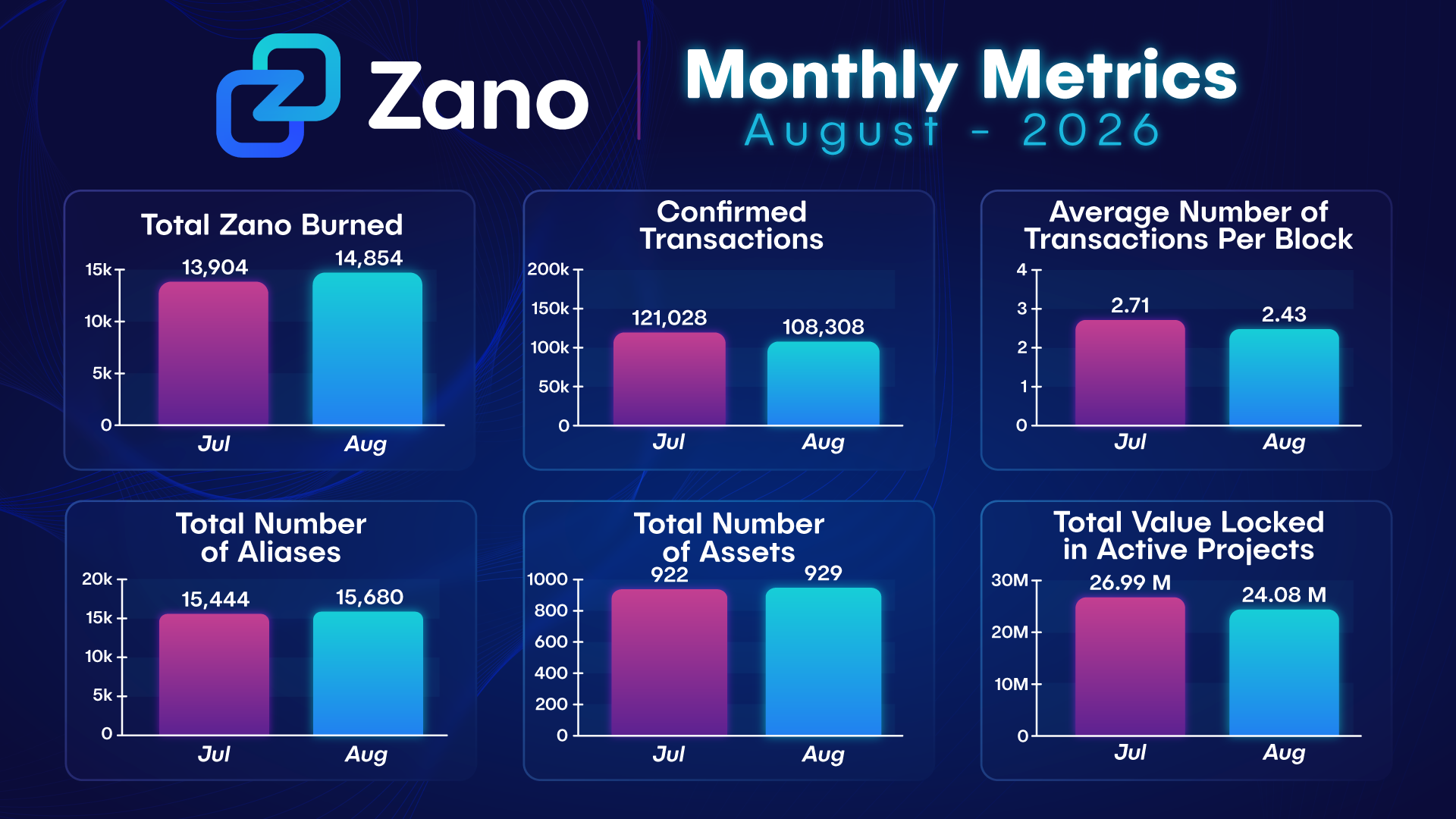
Growth pulled in two directions. Burned $ZANO reached 14,854 against July's 13,904, up about 6.8%, while aliases grew by 236 to 15,680 and Confidential Assets by seven to 929. Confirmed transactions fell 10.5% to 108,308 and the average per block came down from 2.71 to 2.43. Total value locked dropped from $26.99M to $24.08M, roughly 10.8% lower, though that figure is denominated in dollars and moves with price as much as with usage. One quieter month around a fork is not a trend, and we would rather show you the dip than talk around it.
Places to swap, spend and plug in kept accumulating:
- Edge. Bridgeless and the Confidential Layer are live in the app, so BTC, ETH, SOL and others can be held as Confidential Assets on Zano from a wallet people already use.
- Zebec. Zebec's own list of the most-used chains on its SuperApp put Zano alongside Solana, Base, Ethereum and BNB. Top up the Zebec Card with $ZANO or $fUSD and pay through Mastercard.
- AEON Pay. The Telegram mini-app remains the widest spend rail in the ecosystem at more than 50 million merchants, and July's cashback campaign ran through to September 1.
- $wZANO. The transparent EVM version of $ZANO is the on-ramp for anyone starting from a card payment, and after HF6 the route back to native is trustless rather than custodial.
- start.zano.org. A new web app you can set as your browser home page, live now, and the future default start page in the mobile wallet.
Our main page at zano.org was rebuilt as well, with new animations and visuals. The bigger integration story starts now rather than in August: with Gateway Addresses live on mainnet, next comes the exchange and bridge work the fork was built for.
Events
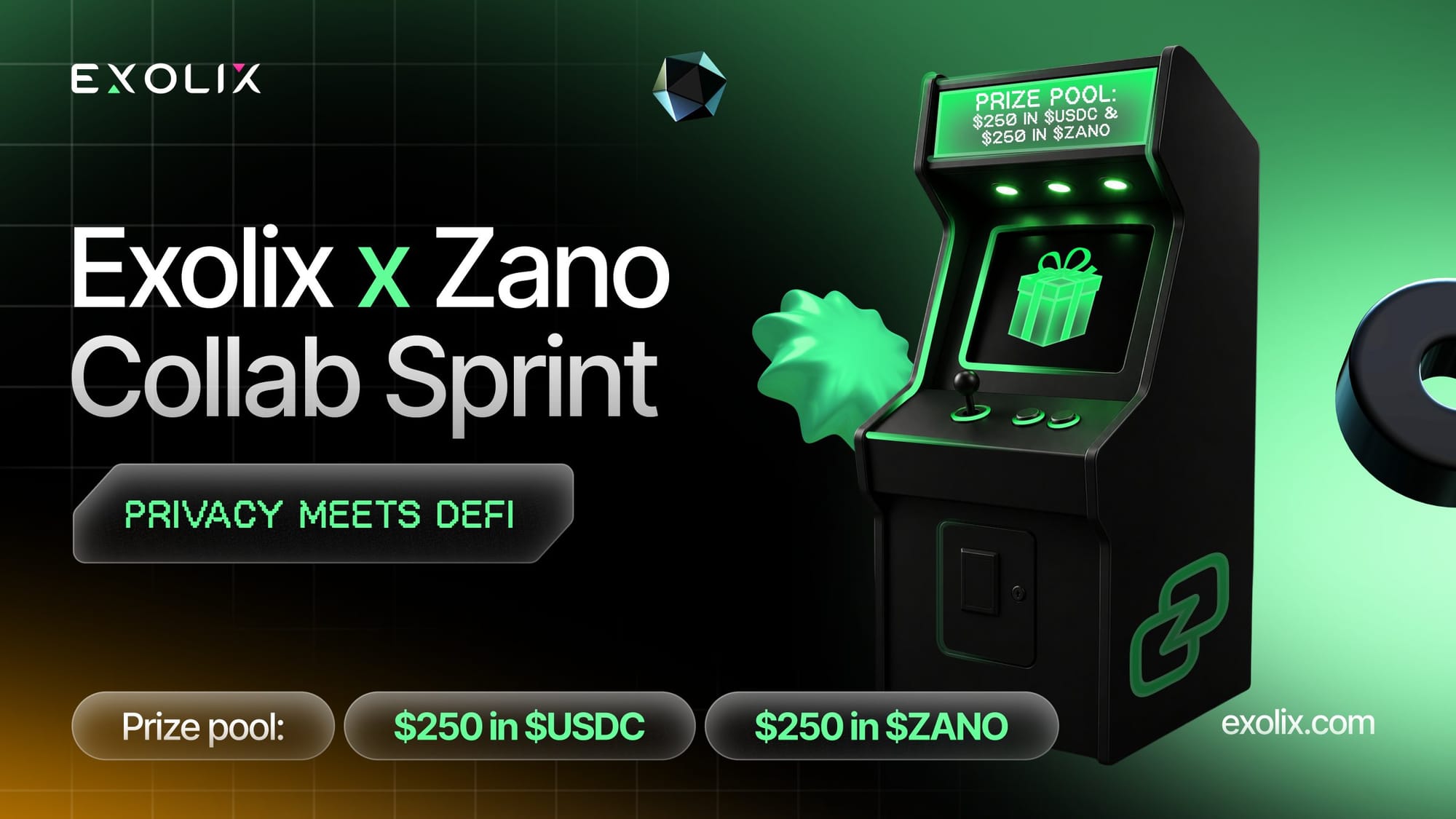
Two dates came out of August. On the 18th we opened a Zealy sprint with Exolix, running until September 3, with $250 in $ZANO and $250 in USDC split across quizzes, guides, memes and content about spending $ZANO in the real world.
Common S3nse comes next, the cypherpunk event in Amsterdam on September 4 and 5, where the team will be in person. Ahead of it, mx12art finished the custom Zano art piece made for the event, live-painted and filmed. Come and find it, and us.
Technical Upgrades
Engineering had two centres of gravity: getting HF6 across the line without surprises, and hardening the mobile Lite wallet ahead of 3.3.1.
Core, Protocol & Consensus
With the fork rules written, this cluster is node resilience and cleanup: making a slow machine fail loudly rather than silently, and deleting code paths with no reason to exist.
- Advanced multi-alias support: an alias can now be marked as the default
- Alternative block lifetime reduced from 1 week to 2 hours (optimization)
- Startup DB performance check added to identify machines too slow to run a node reliably
- Hardened calling sites of
verify_CLSAG_GGX - Additional hardening of bad-tx blacklisting in
handle_block_to_main_chain - Binary serialization to JSON: fixed the
AGGREGATED/FIELDScase - P2P: minor protocol fix, plus default values for
proxy_diagnostic_info - Legacy
getrandom_outs1removed (pre-HF4 PoS block building moved to v3)
Wallet & RPC
Wallet work ran on two threads: bringing older code onto the current decoy selection algorithm, and giving gateway operators the tooling they need now that Gateway Addresses are real.
sweep_belowmigrated to the most recent decoy selection algorithm (v4)- Updated password policy restrictions, with an optional
unsecure-passwordcommand-line flag - Unconfirmed payments are no longer persisted in
m_payments gateway_create_transfernow returns the tx secret key and the list of output addresses, for use withdecrypt_tx_outs_and_update_opdecrypt_tx_detailsfixed for gateway outputs in certain cases- Preliminary range proof check added to block template simulation in certain cases, for more reliable mining
incompatible_serveradded toget_connectivity_statusin the plain wallet API- simplewallet: the
paymentscommand now correctly looks up hex-encoded payment IDs
Build & GUI
Dependencies age, and a wallet is the wrong place to run old cryptography. August moved the desktop stack onto current versions.
- GUI migrated to Qt 6
- GUI secure config encryption migrated to the ROMix-Keccak KDF
- Finally moved to OpenSSL 3.5.7 LTS
- Linux AppImage:
zanodandsimplewalletcan now be run directly from the AppImage - Fixed the
DISABLE_MDBXconfiguration and compilation
Web & Ecosystem
Web work split between the front door and what people click once inside: a rebuilt main page and start page, plus fixes across Companion, the Explorer and the SDK.
Zano Website
- The zano.org main page now showcases Zano's privacy features better, with new animations and visuals
- start.zano.org is live, the new web app covered above
Zano Companion
- Fixed a UI bug that stopped the "insufficient funds" error showing in Ionic swap popups
- Reduced the risk of issues when using multiple Companion extensions at once
Zano Explorer
- Fixed minor UI bugs on the Charts page and inconsistencies in the PoW and PoS difficulty charts
- Block list retrieval optimized: "Latest Blocks" loads and paginates faster, with a loading progress bar
General ecosystem
- Zano Trade and Zano Messenger received minor UX improvements
- Mobile wallet connection issues were addressed across most ecosystem apps where they had occurred
- The
zano_web3SDK was updated to fix permission-request and wallet-connection issues with the mobile wallet
Mobile
Mobile went into hardening the Lite wallet ahead of 3.3.1, with native libraries rebuilt on the HF6-ready core. Much of it is the unglamorous work that decides whether a wallet feels trustworthy: input that refuses nonsense, history that never loses a transaction, errors that explain themselves.
Fixes
- Amount fields: the numeric parser no longer accepts hex, scientific, signed or non-finite input
- Payment IDs: reworked to a proper hex format and displayed as hex bytes, and the Send flow now handles legacy long-payment-ID addresses correctly
- Create Alias is now funds-gated instead of failing with a raw backend error
- History: fixed transfers dropped when a transaction arrives while the wallet is open, history not loading on mobile, and subtransfers missing from recent history
- Settings no longer accept an invalid daemon URL; remote node address validation and the daemon URL input were redone
- Fixed the intermittent node-change warning popup, the cursor jumping to the end when editing, first-login getting stuck and big dialog scrolling; image preview now opens fullscreen
Improvements
- Addresses can now be integrated and auditable at the same time
- Empty states for the Wallets and Settings screens, plus a "no wallet selected" state
- Password strength indicator (in progress)
- Asset details: meta info is copyable, the PIN setup screen has a custom header, and default bookmarks were removed on iOS
- Android target version raised
- Native libraries rebuilt from the latest core on Android, iOS, macOS, Windows and Linux
Zano Fact #3: Did you know Zano deliberately does not use HD wallets? Services handle multi-user custody with integrated addresses instead, which encode a payment ID together with the base address. An address starting with a lowercase i is an integrated one.Media Content & Coverage
The longest piece of the month was not ours. Tyler Spalding, co-founder of Flexa and of the Acronym Foundation, spent an hour on Free the Money episode 40 arguing that privacy is the barrier to real-world crypto adoption. He covers his long-time support for Zano, Confidential Assets, HF6 and Gateway Addresses, cross-chain movement, the Freedom Dollar, AI-era security risks, proof of stake against proof of work, and what Flexa, Zcash and the Spenders Club taught him about making crypto spendable.
Explainer episodes continued on the Zano YouTube channel, covering aliases, auditable wallets and private on-chain voting, still landing every Thursday around 5pm CET.
On August 29 we published a short video comparing the privacy of physical cash with the leakage of a transparent chain, still the clearest way to explain the point.
Cash has kept payments private for centuries. You hand someone a note and it leaves no record.
— Zano (@zano_project) August 29, 2026
On a transparent chain, your balance, your salary, and donations are written in permanent ink.
Zano works like cash but on-chain, with every transaction private by default. 🔒 pic.twitter.com/DIyr1p7FQb
Zano Around the World
Regional teams spent August doing one job across eight regions: getting people ready for the fork.
Zano Africa
Grassroots work in Nigeria had its biggest month yet: five Zano & Friends meetups across Delta, Lagos, Abuja, Kaduna and Zamfara, each built around questions and hands-on interaction rather than presentations, covering financial privacy, the Private Economy and the wider ecosystem. The partnership with Amplify Africa carried Zano beyond Nigeria for an onboarding session with the Kenyan crypto community, and the bi-weekly Zano Africa Community Quiz kept drawing at least 35 players a session.
Zano France
Preparing the community for the fork shaped the whole month. The group grew from 48 to 108 members, producing roughly ten articles every eight to ten days. A dedicated HF6 writing campaign covered what changes and why, and a mid-month quiz got people engaged early. An AMA on the fork was scheduled for the end of August, and a YouTube video on the stakes and implications of HF6 is in preparation for release after activation.
Zano Spain and Latin America
Telegram reached an all-time high with 252 messages, up 37% on the previous month, and the $30 monthly bounty for the region's most active user stayed live. Content set out to dispel doubts about HF6: user guides covering every key feature, higher posting frequency during the countdown, and hand-written analysis of real and potential use cases. Real opinions are now showing up in the comments on X, in what the team calls an oasis in a desert of Spanish-language privacy content. Members are asking about testing Bridgeless and buying wrapped $ZANO or $fUSD on tier-1 exchanges.
Zano Indonesia
Jakarta and Bali carried the month. Zano was represented at Indonesia Blockchain Week on August 12 and 13 with branded apparel and bags, and stickers and brochures handed to Web3 participants; the team also reconnected there with the CEO of MEXC. At Coinfest Asia on August 20 and 21 the focus was offline awareness and physical educational material, and direct contact was established with representatives from KAST. September turns back to community growth and local technical education.
Zano Venezuela
Strategy in Venezuela paired HF6 education with the question people there actually ask, which is whether they can spend it. Crypto debit cards have surged in popularity in the country, so community discussion was pointed at Zebec and its Zano integration as a working example of private payments in daily use. The regional X account grew to 210 total followers.
Zano India
A five-day educational video series ran across X, YouTube and Instagram, covering Zano, privacy, Confidential Assets, Gateway Addresses and Hard Fork 6, alongside three #PrivacyTuesday X Spaces. Offline, the team attended a Bitshala meetup in Noida and connected with a Trezor device engineer, ZK developers, Bitcoin community members and event organisers. Coverage of the BitMela Community Meetup opened talks about a potential Zano-powered event in Delhi, with a customised sponsorship package being followed up. Zano India WhatsApp and Instagram are live, and a Discord is in the works.
Zano Brasil
Education about the fork drove reach, and @zanobrasil grew to 90 total followers, three quarters of the way to the 120 the team set as its phase-two target in July. The more interesting development is a new connection with a specialised DeFi crypto community in Brazil, with a collaboration and a joint X Space currently under discussion.
Zano Bangladesh
Bangladesh reports for the first time. The new ambassador built a local Telegram group to 127 members and an X account to 98 followers, and learned something along the way: an early giveaway brought in roughly 80 Telegram members and 70 followers, and the focus has since moved to organic recruitment of actual privacy enthusiasts. Eight members registered Zano aliases after being walked through the wallet tools. A daily Active Contributor campaign of privacy discussions and quizzes averaged 15 to 18 participants, and an A-to-Z session on HF6 and Gateway Addresses drew more than 20. Bangla content on Zano fundamentals and HF6 mechanics helped the X account reach over 5,600 impressions and 658 engagements.
Looking Ahead
September has three deliverables with names on them. Zano Quest opens soon. Mobile 3.3.1 goes to the stores. The Execution Layer public testnet is still estimated for Q3 2026, and with core, oracle and explorer already running together, that estimate is closer to a schedule than a hope. Behind all three sits the work that matters most and shows least: real exchange and bridge integrations on top of Gateway Addresses.
There is something for you to do as well. If you have not updated your full-node desktop wallet and resynced, do it now at zano.org/wallets. Services should work through the migration guide. The Zealy sprint runs until September 3, and we are at Common S3nse in Amsterdam on September 4 and 5. Support questions belong on the forum or at zano.org/support, never in your DMs: the team never messages first, and wallet support is never given on Telegram or Discord.
Until August 26, the honest answer to "why is Zano not listed there" was that integrating a UTXO privacy chain costs weeks of engineering nobody wanted to spend. That answer has expired. The fork was the part we controlled; what comes next is a set of conversations with other teams, and the Execution Layer will widen the same door from the other side. Privacy nobody can reach is a research project. August was about making it reachable.
Cheers, zAnons!