$ZANO Goes Cross-Chain: Native Zano is Coming to Bridgeless

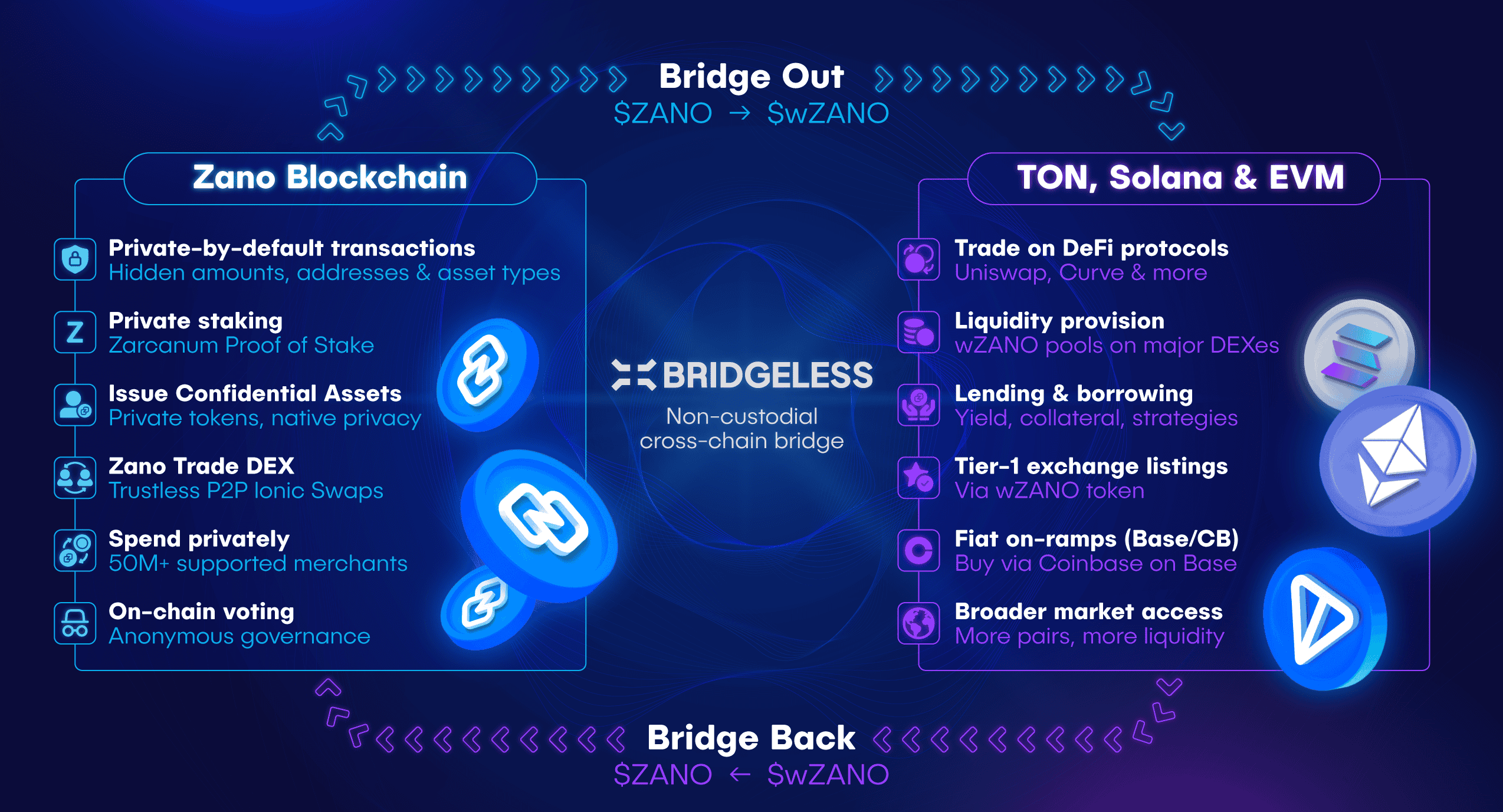
Bridgeless has been a one-way door for a while now.
Assets from public blockchains can be bridged into Zano, wrapped as Confidential Assets, and enjoy full privacy guarantees. That was already meaningful. But after Hard Fork 6, the door swings both ways.
For the first time, native $ZANO, and Confidential Assets supported by Bridgeless, like $fUSD, will be bridgeable to EVM networks, TON, and Solana, through a non-custodial, trustless mechanism that replaces an old compromise with something built the right way.
This isn't just a technical upgrade: it's the infrastructure that could bring $ZANO to tier-1 exchanges and DeFi liquidity pools for the first time.
The Bridge That Already Exists, and Why It Needs Replacing
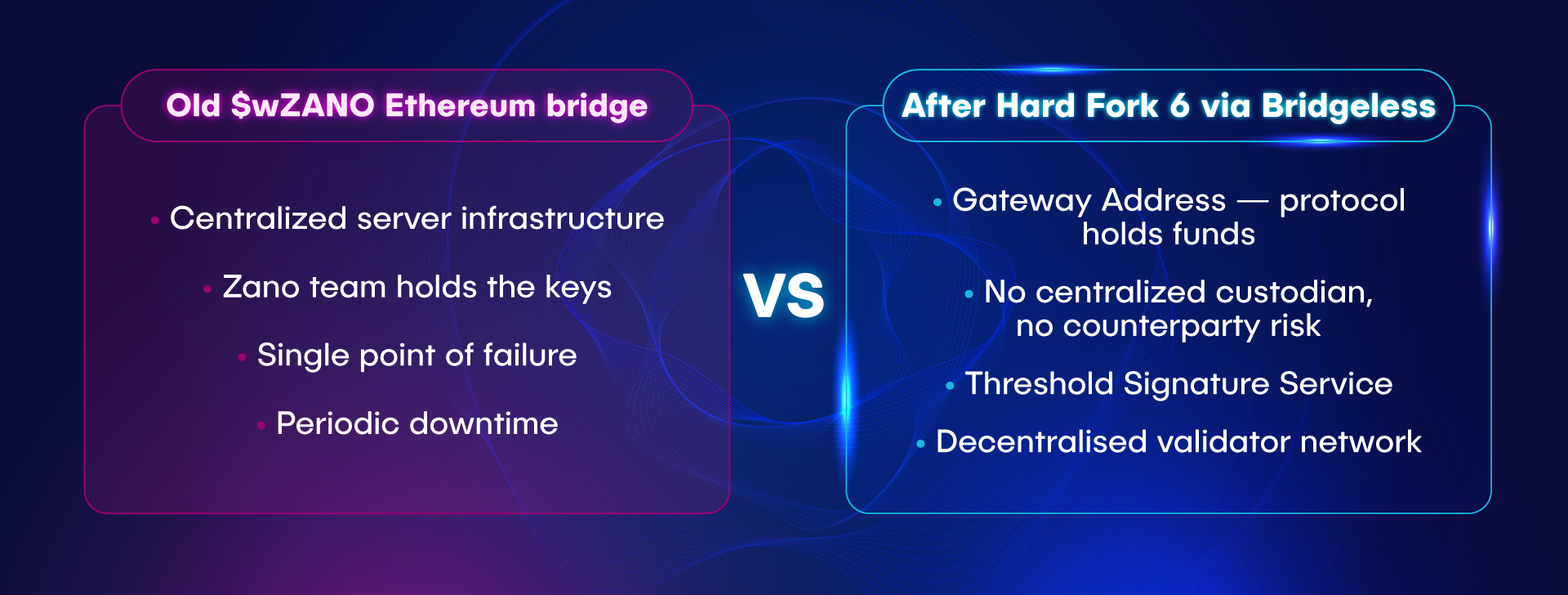
There currently already is a wrapped version of Zano on Ethereum: $wZANO, an ERC-20 token. It's served its purpose, but it was always a workaround. This bridge is operated by the Zano core team and depends on centralized server infrastructure. Community members who've used it know the result well: periodic downtime, and a fundamental reliance on a single point of failure.
Beyond reliability, there's a trust problem. A centralized bridge means a centralized custodian holds the native $ZANO on the other side. You have to trust that the infrastructure stays up, that the keys stay safe, and that access is never restricted. For a project whose entire value proposition is trustless, protocol-enforced privacy, that was always an uncomfortable place to be.
Hard Fork 6 eliminates both problems.
What Changes After HF6
The key enabler is Gateway Addresses, the major new feature introduced in Hard Fork 6. These are a new address type on the Zano blockchain that uses an account-based model instead of the standard UTXO model. They're designed specifically for services like bridges, DEXes, and exchanges that need to interact with Zano programmatically and at scale, and they're what make trustless bridging of native $ZANO and Confidential Assets possible for the first time.
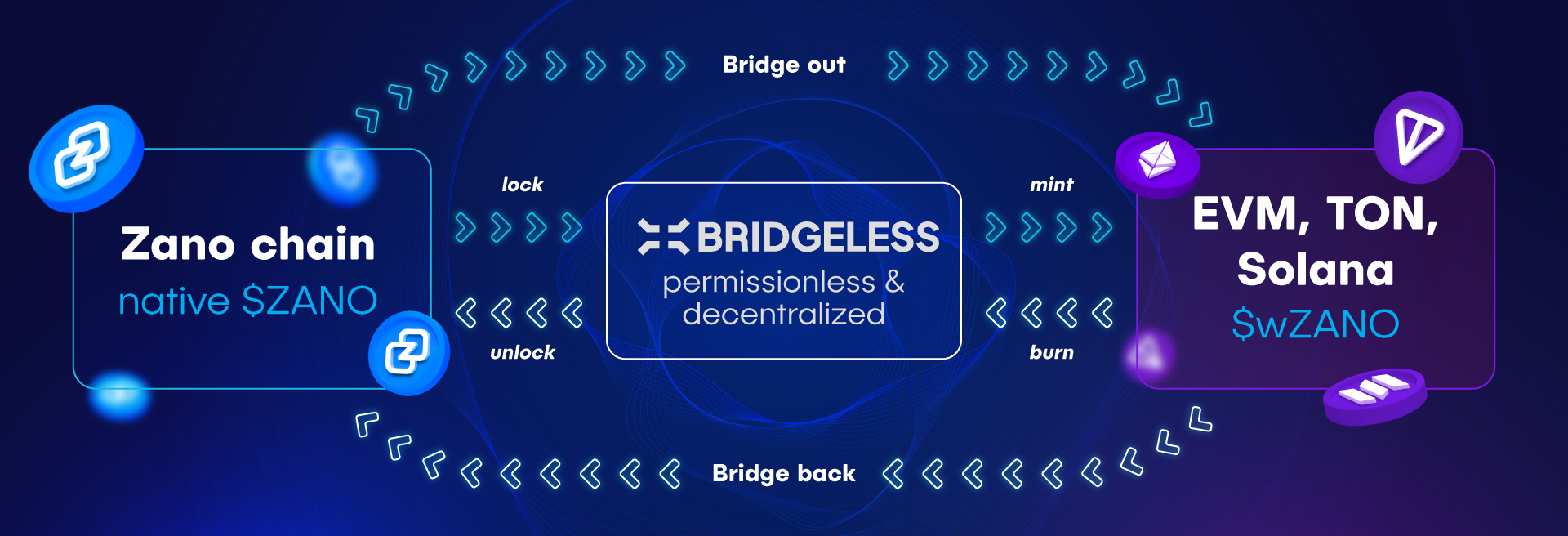
When you bridge $ZANO to an EVM chain, TON, or Solana using Bridgeless, here's what happens:
- Your native $ZANO is locked in a Gateway Address on the Zano side. No human custodian holds it. The protocol does.
- On the other side, an equivalent amount of $wZANO is minted and sent to your EVM, TON, or Solana wallet.
- When you bridge back, the $wZANO is burned, and your native $ZANO is unlocked.
- Every single $wZANO in circulation is backed 1:1 by native $ZANO. Secured by Threshold Signatures, where no single party ever holds the complete private key. No counterparty risk sitting in the middle.
One technical detail worth understanding: Gateway Addresses are transparent by design, a necessary feature for bridge infrastructure. Amounts arriving at and leaving a Gateway Address are visible on-chain. However, your identity as a sender remains protected by Zano's standard privacy mechanisms: stealth addresses keep your address hidden, and ring signatures prevent an outside observer from determining which output you spent. The sending side of the equation stays protected the same way it always does.
Why Bridgeless Is Structurally Different
Bridgeless runs on a decentralized network of independent validator nodes using Delegated Proof of Stake. Cross-chain operations are authorized through a Threshold Signature Service, so no single validator can unilaterally approve a transfer. A cryptographic threshold has to cooperate to sign any operation. On the EVM/TON/Solana side, smart contracts handle deposits and withdrawals. No central server. No single team with unilateral control. No single point of failure.
That said, Bridgeless is currently in an alpha, proof-of-concept phase. Its validator set is still growing, and its native token, $BRIDGE, hasn't been listed yet. The architecture is sound, but this is early-stage infrastructure that will mature as adoption grows and the validator network expands.
Bridgeable to Every Chain Bridgeless Supports as long as it Supports Tokens
$ZANO won't be limited to the Ethereum mainnet. All bridging paths supported by Bridgeless will be available, meaning $wZANO can reach any network on the platform that supports tokenization. Wherever DeFi lives, $ZANO can follow.
What This Opens Up
Getting $wZANO onto other blockchains isn't the destination. It's the starting point.
Zano is purpose-built for privacy. What it doesn't have is smart contract functionality, and that's a deliberate tradeoff. The same design choices that make Zano's privacy guarantees so strong are what keep it focused at the protocol level, without the programmable layer that EVM chains provide. Native DeFi, liquidity pools, lending markets, yield strategies: none of that can exist on Zano's own chain.
Bridgeless changes what's possible. As a standard ERC-20 token, $wZANO can participate in lending protocols, yield strategies, liquidity provision, and more. A $wZANO liquidity pool on Uniswap could replace the existing custodial setup with a non-custodial equivalent, giving traders a more reliable way to swap in and out of $ZANO directly on Ethereum. These are categories of DeFi activity that $ZANO holders simply couldn't access before, without giving up custody or routing through centralized intermediaries.
One tradeoff to be clear about, though. The moment you bridge to Solana, TON, or any EVM chain, you leave Zano's privacy protections behind. Your $wZANO balance and transaction history are publicly visible on-chain, just like any other token on these transparent blockchains. Hidden amounts, hidden addresses, untraceable transactions: none of that carries over. Bridging to these transparent networks is for DeFi participation and broader accessibility. If privacy is the priority, native $ZANO on the Zano blockchain is where you want to be. Bridging back restores those protections fully.
A New Path to Tier-1 Exchange Listings
Native $ZANO has faced real resistance from tier-1 exchanges. Its strong privacy features, the same features that make it technically superior, have led to outright rejections from major platforms unwilling or unable to list coins with default transaction privacy. That ceiling has made it harder for new users to access Zano.
$wZANO changes the equation. As a transparent asset, it doesn't carry the same compliance friction on centralized platforms. This makes it significantly more viable for tier-1 listings. For anyone who wants exposure to Zano, the path becomes straightforward: buy $wZANO on a well-known exchange, withdraw it to a self-custody wallet, and bridge it to native $ZANO through Bridgeless or a compatible wallet to unlock the full privacy stack. No technical barriers. No niche exchange accounts.
Purchasable with Fiat Through Coinbase
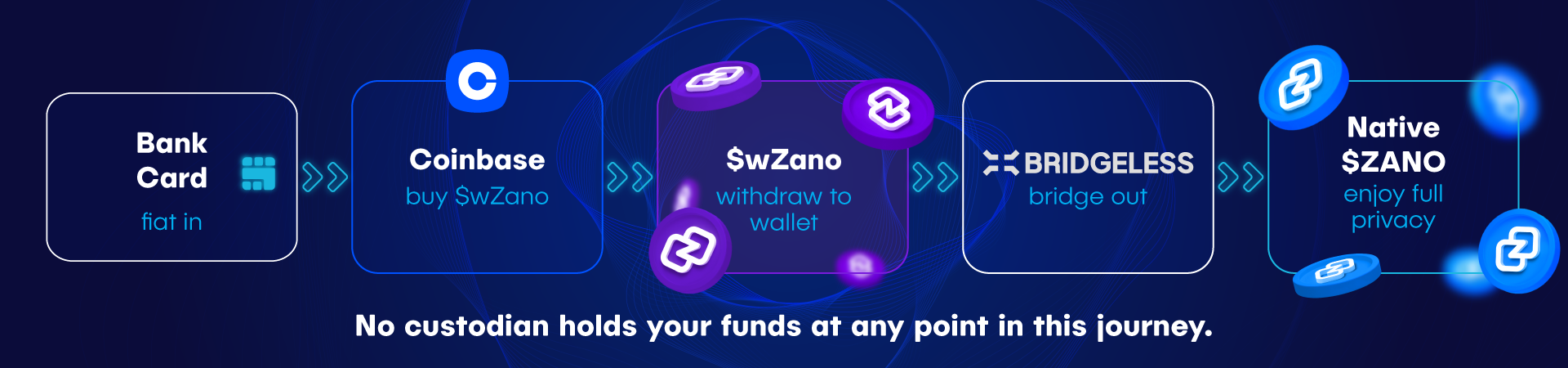
Launching $wZANO on Base is part of our rollout plan, as it opens a direct fiat on-ramp that didn't exist before. Any token on the Base ecosystem is automatically purchasable with fiat through the Coinbase app, meaning anyone with a Coinbase account will be able to buy $wZANO directly with a bank card, no crypto experience required. From there, they can withdraw to a wallet like Edge Wallet or Bitcoin.com Wallet, both of which already support Zano, and bridge to native $ZANO in a few clicks.
From a bank card to full protocol-level financial privacy, with no custodian holding your funds at the end of it. That user journey didn't exist before.
How to Bridge
Bridging will be accessible through the Confidential Layer website and app. Wallets that already support Zano, including Edge Wallet, Cake Wallet, Unstoppable Wallet, and Bitcoin.com, could also support the bridging flow directly within their interfaces. Edge has already committed to support this.
The Bigger Picture
Bridgeless originally brought the outside world into Zano. Assets from public chains can be wrapped and used privately within the ecosystem. That was completed in July 2025.
What's coming next is the other side of that picture. The same $ZANO that you mine, stake, and hold privately can now operate as a first-class asset across DeFi chains, backed by decentralized infrastructure, with no team controlling your funds and no server to take it offline.
Hard Fork 6 is targeted for Q2 2026. The testnet for Gateway Addresses is already running. Privacy is about to become a lot more accessible to the average user!