Gateway Addresses Are Coming: The Game-Changer For Zano Adoption

Privacy alone doesn't build an ecosystem. You need the world to be able to plug into it.
That's been Zano's quiet challenge for a while now. The technology has been ahead of the curve for years. Zarcanum brought private Proof of Stake. Confidential Assets brought private tokens. The cryptography is bulletproof. But bridges, exchanges, and other platforms still found Zano difficult to integrate, not because the tech was bad, but because the operational model didn't fit their workflows.
Hard Fork 6 is changing that. And the feature doing the heavy lifting is Gateway Addresses.
They've already been successfully launched on Zano's testnet and are being put through their paces as we speak. The groundwork is being laid right now, and what follows is everything you need to know about why this is one of Zano's most important steps yet.
The Problem Worth Understanding
Zano runs on a UTXO model. It's core to how Zano delivers privacy, untraceability, and hidden amounts. But for services that need to custody and move funds at scale, UTXO creates real headaches.
Imagine you're running a bridge or a DEX. Every time you need to check a balance, your software has to dig through chain history, piece together dozens of spendable outputs, and reconstruct the current state from scratch. On top of that, the standard institutional custody tools that big platforms rely on weren't built with UTXO privacy chains in mind. Integrating Zano meant building custom solutions for problems that simply don't exist on other chains.
That engineering overhead has a cost. It pushes Zano down the integration priority list. And every integration that doesn't happen is an adoption opportunity missed.
Gateway Addresses are the solution.
An Account Model, Without Touching the Privacy Layer
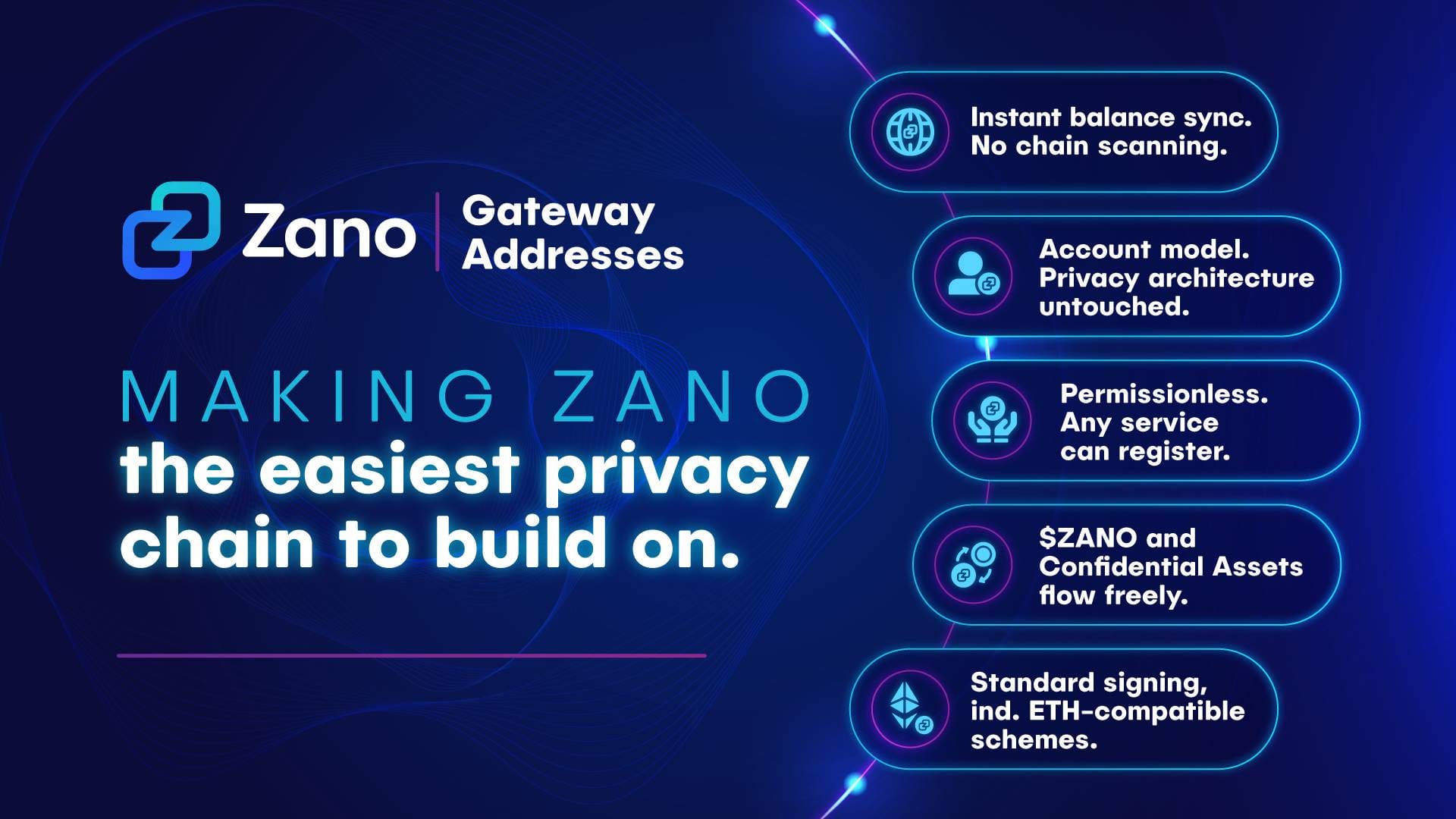
A Gateway Address is a new type of Zano address that works like an account instead of a UTXO wallet. Rather than representing funds as a scattered set of spendable outputs that need to be scanned and reconstructed, a Gateway Address maintains a single, directly tracked balance on-chain.
For a service operator, the experience shifts from "scan the chain, rebuild the state, figure out what you have" to simply "here's your balance." It's the difference between piecing together a puzzle every time you want to check your bank account versus just opening the app.
And critically, none of this touches Zano's existing privacy model. Standard Zano addresses stay exactly as they are. Gateway Addresses are an additional address class designed specifically for services, built alongside the existing architecture rather than replacing it.
Why Instant Sync Is a Bigger Deal Than It Sounds
One of the biggest practical wins here is something called instant sync, and it matters more than the name suggests.
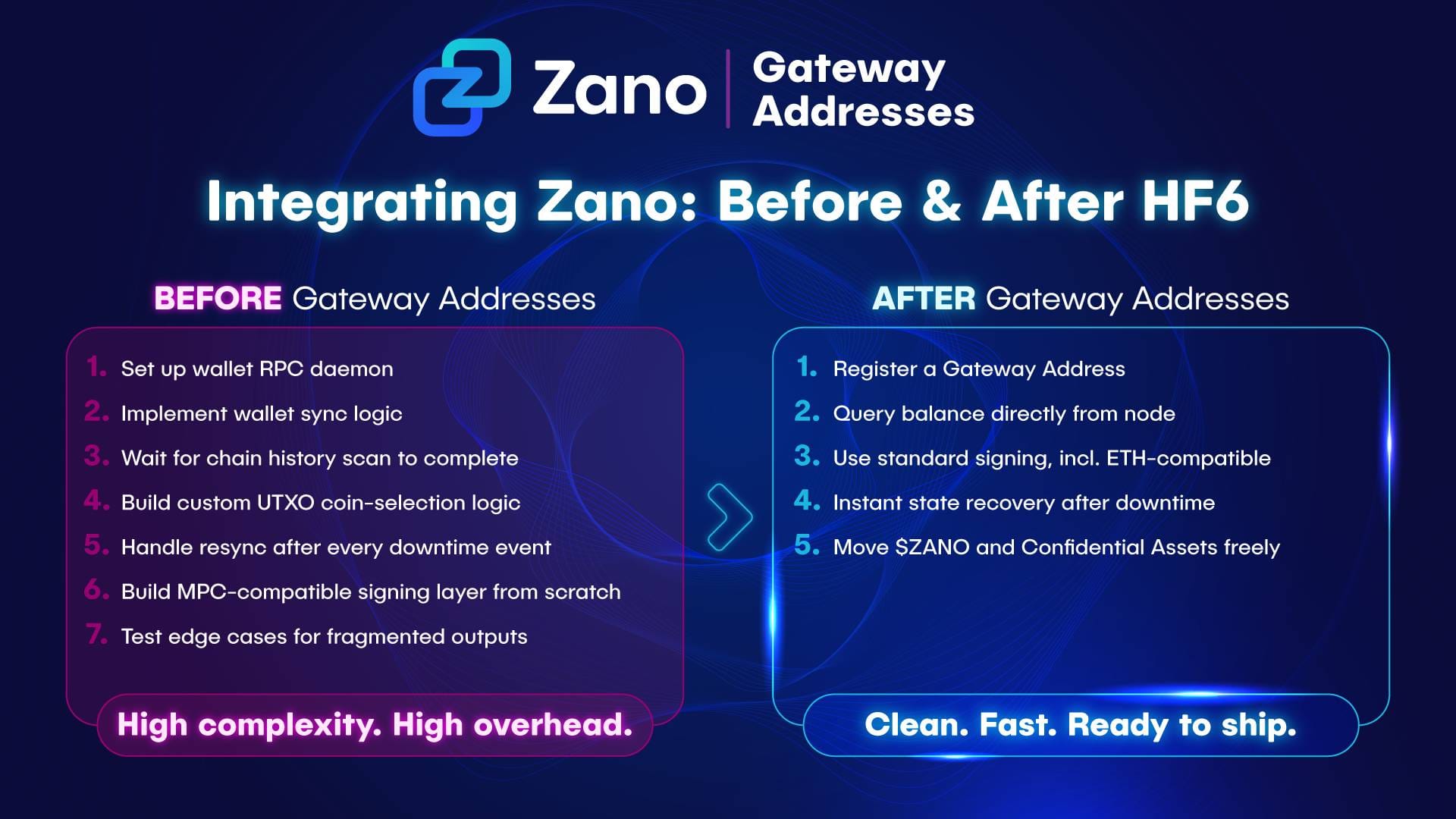
Under the current Zano model, a service that goes offline and comes back up must resync its wallet. Depending on the transaction history, that can take a serious amount of time. For an exchange or bridge, downtime costs money and erodes user trust.
With a Gateway Address, that problem disappears. The current balance is always available directly from the node, no scanning required, no reconstruction process, no waiting. A service can go down and come back up at full operational speed, and that's a fundamentally different operational reality for any platform running Zano infrastructure.
Both $ZANO and Confidential Assets Can Flow Through
Both native $ZANO and Confidential Assets can flow freely between Gateway Addresses and regular Zano addresses. This is a bigger deal than it might initially sound.
Confidential Assets already allows external tokens to be wrapped and represented inside Zano. Gateway Addresses complete the other side of the picture by enabling the practical bridging of assets out of Zano, including native $ZANO itself. Zano's roadmap explicitly ties Gateway Addresses to cross-chain compatibility and native ZANO bridging via Bridgeless. The pieces are falling into place.
A Transparency Layer That Doesn't Leave Users Exposed
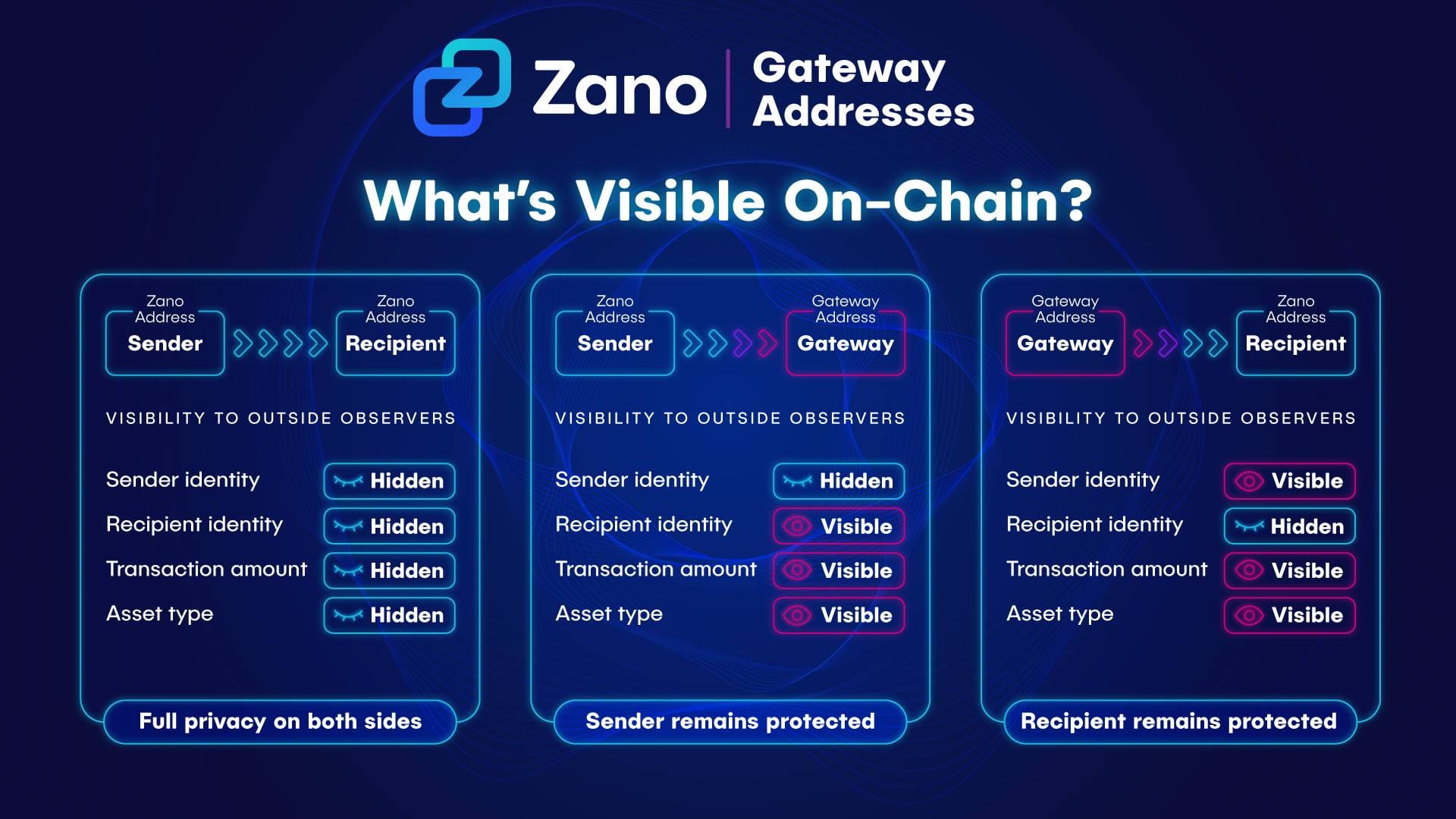
Gateway Addresses are transparency-oriented by design because the services using them need that transparency to function. Balances are open, and transferred amounts are visible to observers at the Gateway level.
But that doesn't mean users are left exposed. Your identity as the sender remains hidden through Zano's stealth address model, so your address never appears on-chain. The ring signature mechanism still applies on top of that, so an outside observer has no way to determine which output was actually spent, with the sender remaining hidden through commitments and stealth addresses as always.
What changes compared to a regular Zano transfer is specifically that the destination is a transparent Gateway Address with a visible balance, meaning the amount arriving there and the asset type are visible. The sending side of the equation stays protected the same way it always does.
The team is also researching whether future versions of Gateway Addresses can support hidden amounts, which would close that gap as well.
The Difference With Auditable Addresses
Zano already has auditable addresses, which let a wallet be made transparently verifiable by third parties, useful for things like proving reserves or disclosing treasury activity. It's worth being clear that Gateway Addresses are a completely different tool for a completely different purpose.
Auditable addresses are about transparency for accountability. Gateway Addresses are about integration compatibility. One is a transparency tool. The other is an infrastructure tool.
Registering a Gateway Address
Gateway Addresses are a permissionless protocol feature, meaning anyone can register one. To keep it firmly in the hands of serious service operators rather than everyday users, registration carries a 100 ZANO fee. That fee gets burned, which means every Gateway Address registered contributes directly to $ZANO's deflationary supply model. Good infrastructure that pays for itself in more ways than one.
The DEX Integrations That Are Already on the Table
Here's where things get really exciting.
Gateway Addresses don't just make integrations easier in theory. They enable Zano to connect with major decentralized exchanges that have been out of reach until now. We've already been in touch with Thorchain, Near Intents, Maya Protocol, and several other significant DEX platforms, and they've expressed a genuine willingness to explore integrating Zano once Gateway Addresses go live on mainnet.
These aren't cold leads. These are conversations that are happening right now, backed by the technical foundation that Gateway Addresses provide.
Near Intents is one of the most innovative intent-based trading protocols in the space, handling cross-chain swaps across a growing number of assets. Maya Protocol is a leading liquidity protocol built for native cross-chain swaps, without wrapping, without bridges in the traditional sense. Getting $ZANO listed and tradeable on platforms like these would be a boost in Zano's accessibility and liquidity that we simply couldn't achieve before.
Real integrations, with platforms that millions of users already rely on. That's what this unlocks.
The Testnet Is Running. The Hard Fork Is Coming.
Gateway Addresses are live on testnet and are being thoroughly tested right now. The hard fork that brings them to mainnet is on the horizon, and when it arrives, the integrations and conversations that have been building behind the scenes can finally move forward.
Zano has spent years becoming one of the most technically advanced privacy chains in existence. But technical excellence only gets you so far if the world can't easily connect to it.
Gateway Addresses are the bridge between Zano's world-class privacy infrastructure and the exchanges, platforms, and protocols that drive real adoption. They don't compromise what makes Zano special. They make what's special about Zano accessible to everyone who wants to build with it.
HF6 isn't just another upgrade. It's Zano opening its doors to the rest of the industry. The testnet is running. The conversations are happening. The integrations are coming.
