Zano's Path Forward: Our Priorities for the Months Ahead

Since the updated chain continued on September 27, the network has been stable, and every service and exchange has reopened ZANO and fUSD deposits and withdrawals and resumed operations.
We've also used this time to take a hard look at our priorities. The way vulnerabilities are found is changing fast: AI tools make it easier than ever to scan code for weaknesses, for attackers and defenders alike. So we decided to reinforce Zano's codebase first, before building further on top of it. That choice affects our roadmap, and this article explains how. Below, you'll find where we stand on security, our two main priorities, Gateway Addresses and Zenith, what's launching in the ecosystem in the meantime, and where things stand on accessibility and liquidity.
Security first: auditing the current codebase
After the Gateway Address vulnerability, one question mattered more than any other: is the rest of Zano's supply logic sound? We set out to answer it with two separate, automated audits of the current mainnet, the version running since Hard Fork 7.
An automated audit by zkSecurity. zkSecurity ran an automated audit of the full Zano codebase through zkao, its automated auditing platform, focused specifically on emission and supply. zkao's findings are produced by a combination of cyber-capable AI models, including Mythos and Daybreak, with zkSecurity's methodology behind them.
An automated audit by the Zano team. In parallel, the team ran its own scan of the full codebase using Claude Mythos 5.1 & 5.2 through the Cyber Verification Program, with instructions and context provided by our developers, targeting inflation and supply-related vulnerabilities: the class of bug behind the Gateway Address incident.
Neither audit found anything exploitable in the current mainnet's emission logic.
We started with supply because it is the most sensitive part of any currency. Next are scans covering consensus, privacy, the network protocol, and other attack vectors, and automated scanning like this will become an ongoing part of how we review Zano's code.
Security comes first, always, and that takes real time. Right now, about 70% of our development time goes into reviewing and fixing issues surfaced by AI-assisted scans like these. We work on the roadmap alongside that, which is why the dates in this article are estimates: when security needs more time, the roadmap moves with it.
That leaves two priorities on the roadmap: bringing back Gateway Addresses and Zenith. We're working on both in parallel, and we can't say yet which will be delivered first.
Bringing back Gateway Addresses
Gateway Addresses were introduced with Hard Fork 6 to let exchanges, bridges, and decentralized exchanges connect to Zano through a system they already know. They give a service an address whose balance can be read and checked on-chain, while every standard Zano address stays fully private. That makes them the key to integrations that need to verify balances.
Since the incident, Gateway Addresses have been disabled through Hard Fork 7. The fix itself is straightforward: as our post-mortem explains, the code was missing a check that the asset IDs on Gateway outputs reference registered assets, and adding that check closes the vulnerability.
What takes time is everything around the fix. Rather than auditing only the minor changes, we're auditing Gateway Addresses in full: every part of the code, and how it interacts with the rest of the protocol. They will only return once we’re fully confident they’re sound. This work, including the audits, is currently estimated for Q1 2027, after which Gateway Addresses will be reactivated through Hard Fork 8.
To support that, we're building a hard fork booster: a feature that makes it possible to adjust the activation height of an upcoming fork in either direction. It can bring a fork forward in an emergency or push it back if an audit finds something that needs more work. That gives us the flexibility to activate Hard Fork 8 at the right moment, rather than at a height fixed in advance.
The booster doesn't change who decides. Like every hard fork, Hard Fork 8 only takes effect when node operators, stakers, miners and exchanges choose to update their node with the code that activates the hard fork. The booster adjusts when an upgrade activates, not whether the network adopts it.
Infrastructure providers will also get plenty of notice. Exchanges, wallets, pools and other services will receive the release and its activation height at least a few months in advance, so they have time to update before the fork activates. With the hard fork booster the team would then be able to move forward faster when its needed, by making sure that every integration and majority of the networks got updated before taking an action on HF activation.
The work on Gateway Addresses, including the audit, is currently estimated for Q1 2027. Gateway Addresses return once the code has passed its audit, not before.
The road to THORChain
Buying ZANO today still means going through a centralized exchange. Some require KYC, and all of them are custodial. THORChain offers a different route: no account, no KYC, and no dependence on where you live. Its integration depends on Gateway Addresses because THORChain needs to verify vault balances on-chain. So the path to permissionless access to ZANO runs directly through the Gateway Address audit.
The THORChain team has committed to integrating ZANO once Gateway Addresses return to Zano’s mainnet.
Zenith: Zano's move to pure Proof of Stake
Zenith is Zano's move to pure Proof of Stake, designed in collaboration with Common Prefix, who review every part of it, and built on Zarcanum, the private Proof of Stake that has secured Zano since 2024. With Zenith, stakers secure the network without miners, with their balances kept private.
For users, Zenith means a more secure, faster network: block times of about 15-20 seconds and typical confirmations after 3-4 blocks, for about 60 to 90 seconds total. Zenith's testnet is currently estimated for Q1 2027, with mainnet following in Q2 2027. Together with Gateway Addresses, it's our main development priority, ahead of the Zano Execution Layer. Like everything else, it will undergo extensive security review before going live.
The Zano Execution Layer follows Zenith
The Zano Execution Layer (ZEL), a separate EVM chain connected to Zano through a threshold-signature bridge, will launch on mainnet after Zenith. Its bridge depends on Gateway Addresses, so it can't go live before they return.
Development hasn't stopped. ZEL's public testnet continues, and recent work added bridge controls, deposit and withdrawal limits, clearer bridge and swap interfaces, and a redesigned staking interface. In the meantime, Bridgeless remains available for bridging wrapped assets to and from Zano.
In the meantime
While the core priorities take shape, several new ways to use and grow Zano are launching.
Zano Quest
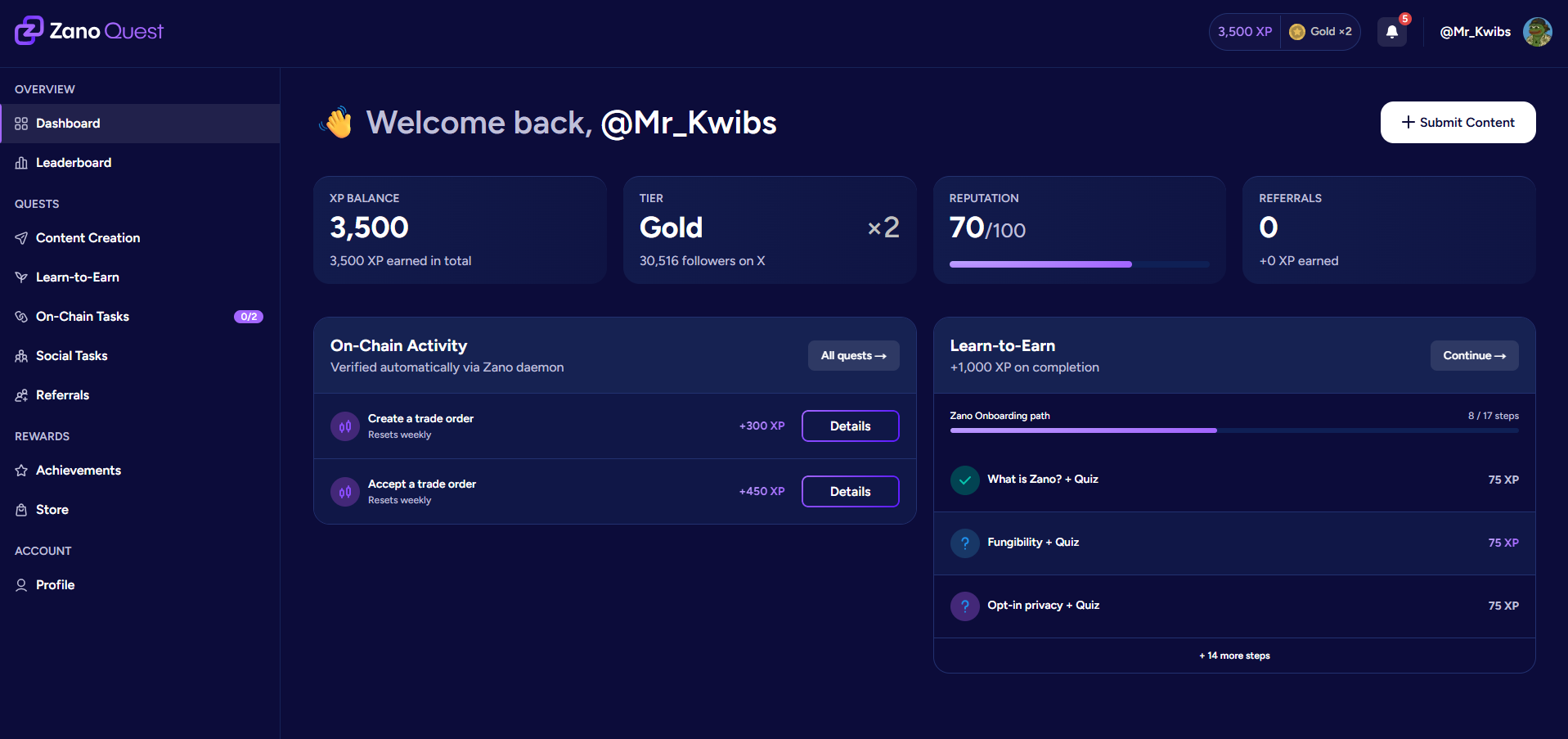
Zano Quest launches on December 1. It brings referrals, learning, on-chain activity and content creation together in one place. You earn XP by completing tutorials and quizzes, making real on-chain actions like sending a transaction or minting a Confidential Asset, creating content about Zano, and referring others.
Quest will run in monthly seasons, each with its own reward pool, and you can convert your XP into ZANO. Leaderboards, badges and creator multipliers are all live from day one, so the more you contribute, the more you earn.
Zano Names
ZanoNames, built by community member Mr Fox, is now live at zanonames.com. It's a marketplace for buying and selling Zano aliases, with escrow-backed trades verified on-chain. You can buy an alias at a fixed price, make an offer in ZANO or fUSD, post a "wanted" request for a name you're after, or list your own. More than 100 aliases are already listed. If you'd rather claim a new alias, Freedom Wallet lets you register one directly in the app, from as little as 0.11 ZANO.
Zano aliases are about to become tradable.
— Zano (@zano_project) October 29, 2026
Buy, bid at auction, or make an offer in $ZANO or $FUSD, with escrow holding the payment until the transfer is confirmed on-chain.@ZanoNames is launching soon. 🔒 pic.twitter.com/lN73i23TJ6
A redesigned Zano Trade
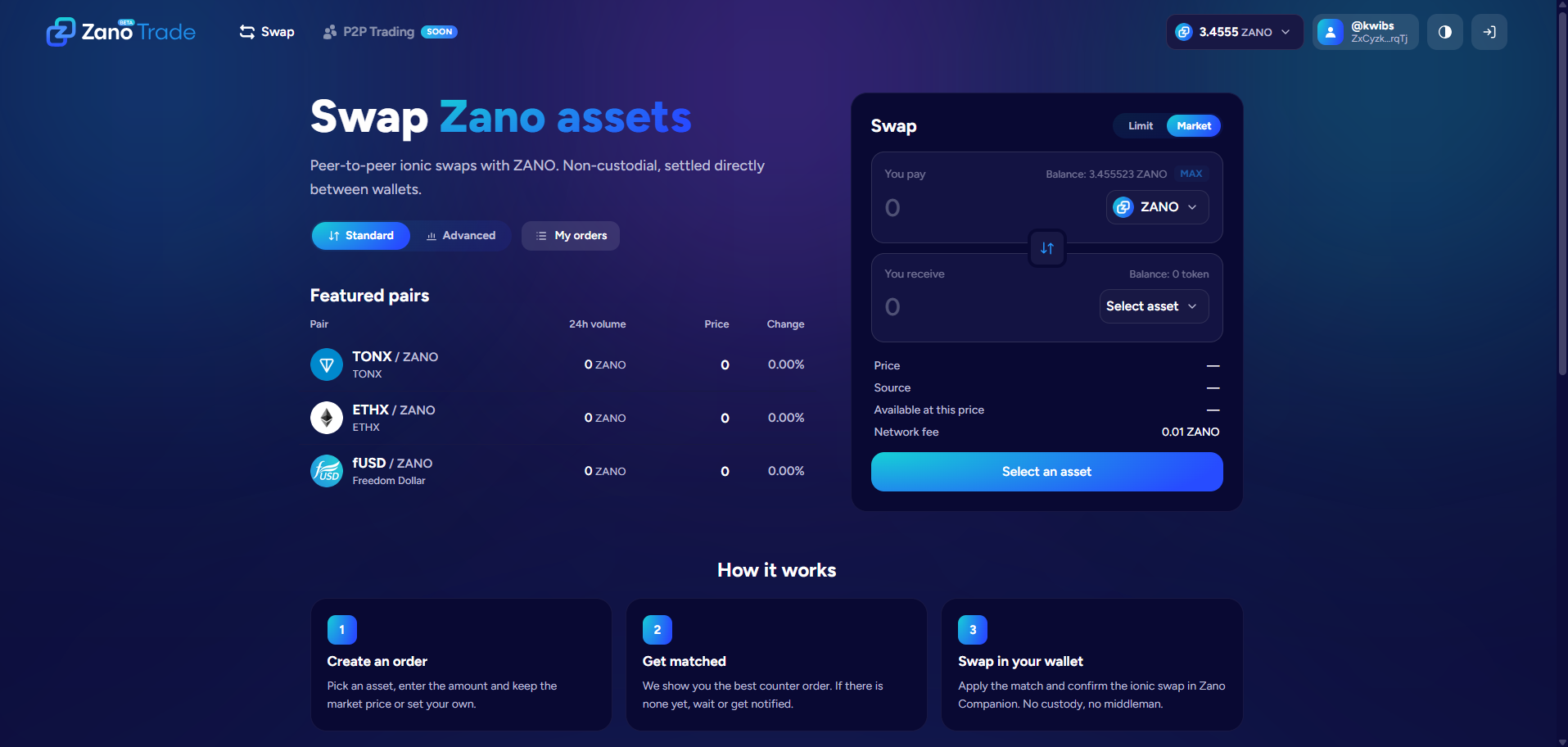
Your feedback taught us something important about Zano Trade: the current interface is relatively hard to use, and that has limited how much people use it. A great trading tool only helps if people find it easy to use, so we redesigned it.
The new Zano Trade, released before the end of the year, feels like a swap platform: straightforward and simple. Pick an asset, enter an amount, and either keep the market price or set your own with a limit order. Zano Trade shows you the best counter order, or notifies you when one appears, and you complete the ionic swap in Zano Companion: no custody, no middleman. Traders who want more control can still switch to advanced mode.
BTCPay Server integration
The core team built a BTCPay Server plugin that lets merchants accept ZANO and all Confidential Assets through one of the most widely used self-hosted payment processors. It's compatible with BTCPay Server 2.4.5, and testnet payments have been verified. The public release and directory listing are next. This integration will make it much easier for merchants to accept ZANO and Confidential Assets. Therefore, we expect ZANO & CAs to become more spendable at various places.
Accessibility and liquidity
All exchanges have reopened ZANO and fUSD deposits and withdrawals and resumed trading, but the wider picture remains challenging. Several mid-tier exchanges have been closing, and most swap platforms have stopped offering ZANO because of a MEXC API policy change.
That's why the priorities above matter beyond the code. Gateway Addresses open the door to THORChain and permissionless access. The BTCPay plugin brings ZANO to merchants who run their own payment infrastructure. And there are already more ways to use ZANO in daily life: gift cards from more than 1,600 brands through CardsRelay, and payments at more than 50 million merchants through AEON Pay and Zebec.
To improve Zano’s accessibility in the meantime, we’ve connected our third-party wallets (Bitcoincom, Unstoppable, Edge, and Freedom Wallet) with platforms like Wizardswap, ZanoX, and Freedom Swap, where swapping ZANO & fUSD is still available. Most of them are now looking to integrate these solutions into their wallets so they can offer in-wallet swaps for the Zano ecosystem again.
The updated roadmap
Zenith and bringing back Gateway Addresses are our priorities, and the updated roadmap reflects the shift toward security first. In short:
Now (Q4 2026)
- The redesigned Zano Trade UI
- The launch of Zano Quest
- The BTCPay Server plugin
- Continued work on the Zano Execution Layer's public testnet
- Continued development of Zenith
- Research into Full-Chain Membership Proofs for Zarcanum and Confidential Assets
Next (first half of 2027)
- Gateway Addresses: reimplementation and audit, estimated for Q1 2027
- Zenith testnet, estimated for Q1 2027, followed by mainnet, estimated for Q2 2027
- Research other DEX integrations using Gateway Addresses
- A new mobile wallet app and a privacy upgrade to Zano's peer-to-peer networking
After Zenith
- The Zano Execution Layer mainnet, cross-chain swaps and native ZANO bridging into ZEL
Further ahead
- Hardware wallet support, dynamic fees, multisig, a premium alias auction, a grants program, and research into a Zano VM
All dates are estimates, and security reviews come first. If an audit takes longer, the roadmap will move with it.
Review the full roadmap here: https://zano.org/roadmap
Looking ahead
Security comes first, always. We continue to audit our entire codebase with the latest models. Gateway Addresses and Zenith are both priorities, and each will be delivered once it's ready and has passed its security review, whichever comes first. The Execution Layer follows Zenith. And in the meantime, there's more to use on Zano than ever.
Thank you for your patience and support over the past weeks. Questions are always welcome on forum.zano.org and in our official Telegram, where you're always talking to the actual team.